Walk through any hospital ward in Pakistan and you will notice something quickly: behind every nurse there is a quieter pair of hands doing the work that keeps the ward running. Someone checks the patient’s blood pressure, helps them sit up for a meal, changes the bedding, and notices — before anyone else — that a patient looks more tired than they did an hour ago. That person is very often a Certified Nursing Assistant, and the CNA course in Pakistan is the shortest route into that role.
This guide covers the CNA course honestly: what it is, how long it takes, who can apply, what you will learn, and where it can take you afterwards. Every fact about RIAHS here comes from the institute’s own programs and admissions pages, verified today. Where a detail depends on the current admission cycle — fees, dates, merit lists — we say so plainly instead of guessing.

Key Takeaways
- The CNA (Certified Nursing Assistant) course at RIAHS is a 1-year program — the shortest of the institute’s Category C programs.
- It is a Category C program under the Punjab Medical Faculty (PMF) affiliation.
- Eligibility: Matric (any group) with a minimum of 45% marks, on a merit basis.
- Unlike LHV and CMW, no gender restriction is listed for CNA on the admissions page.
- CNAs provide basic patient care, monitor vitals, and support nursing staff in hospitals, clinics, and long-term care facilities.
- Fee details are shared on a campus visit or WhatsApp inquiry — no fee figure is published on the admissions page, and none is claimed here.
Table of Contents
- What Is a CNA Course?
- How Long Is the CNA Course?
- Who Can Apply for the CNA Course?
- What Subjects Will You Study?
- CNA vs LHV vs CMW: What Is the Difference?
- Career Scope of a CNA in Pakistan
- How to Apply at RIAHS
- Frequently Asked Questions
What Is a CNA Course?
A Certified Nursing Assistant is the healthcare worker who handles the hands-on, day-to-day care of patients. Nurses plan and manage care; CNAs deliver much of the direct bedside work — helping patients eat, bathe, and move around, checking vital signs, keeping records tidy, and reporting changes in a patient’s condition to the nursing staff. It is unglamorous work, and it is also the work patients remember most: the person who was kind, careful, and present when they felt at their worst.
At the Ravi Institute of Allied Health Sciences (RIAHS) in Shahdara, Lahore, the CNA program sits in Category C — the institute’s “Other Programs” group — alongside LHV, CMW, and the B-Category Pharmacy Technician program. RIAHS is a PMF-affiliated institute, so its programs run under the Punjab Medical Faculty framework. You can compare all the programs on the RIAHS programs page, and the official PMF site is pmfpunjab.edu.pk.
How Long Is the CNA Course?
Is the CNA course 1 year long?
Yes. At RIAHS, the CNA — Certified Nursing Assistant program is a 1-year program. That makes it the quickest entry point among the institute’s allied health programs: half the length of the two-year Category A and Category B programs, and shorter than the 18-month CMW program. For a student who wants to start working in healthcare without committing to two years of study first, that one-year length is a genuine advantage — but it also means the training is focused and practical from the start, with little room for drifting.
Exact class schedules and start dates change from one admission cycle to the next. RIAHS announces current dates on its Notice Board, so check there — or ask the admissions team directly — rather than relying on a date you read in an old article, including this one.
Who Can Apply for the CNA Course?
What is the eligibility for the CNA course in Pakistan?
To apply for the CNA course at RIAHS, you need Matric from any group with a minimum of 45% marks in your board examination. Unlike the Category A programs, which require Matric (Science) with Biology, Chemistry, and Physics, Category C programs accept Matric from any group — so students from arts or general streams are not shut out. Selection is on a merit basis, with higher Matric marks prioritised and seats limited.
| Requirement | Detail (RIAHS) |
|---|---|
| Qualification | Matric (any group) |
| Minimum marks | 45% in board examination |
| Gender | No gender restriction listed for CNA (LHV and CMW are female-only) |
| Duration | 1 year |
| Category | Category C — Other Programs |
| Selection | Merit basis; seats limited |
What documents do I need to apply?
RIAHS asks for your CNIC or B-Form (original plus a copy), your Matric certificate (original plus two copies), and four recent passport-size photographs. Keep originals ready for verification when you visit the campus or submit your application — it saves a second trip.
Can I apply for CNA after Matric with arts subjects?
Yes. Category C programs, including CNA, accept Matric from any group, provided you have at least 45% marks. You do not need Matric (Science) for this program.
What Subjects Will You Study?
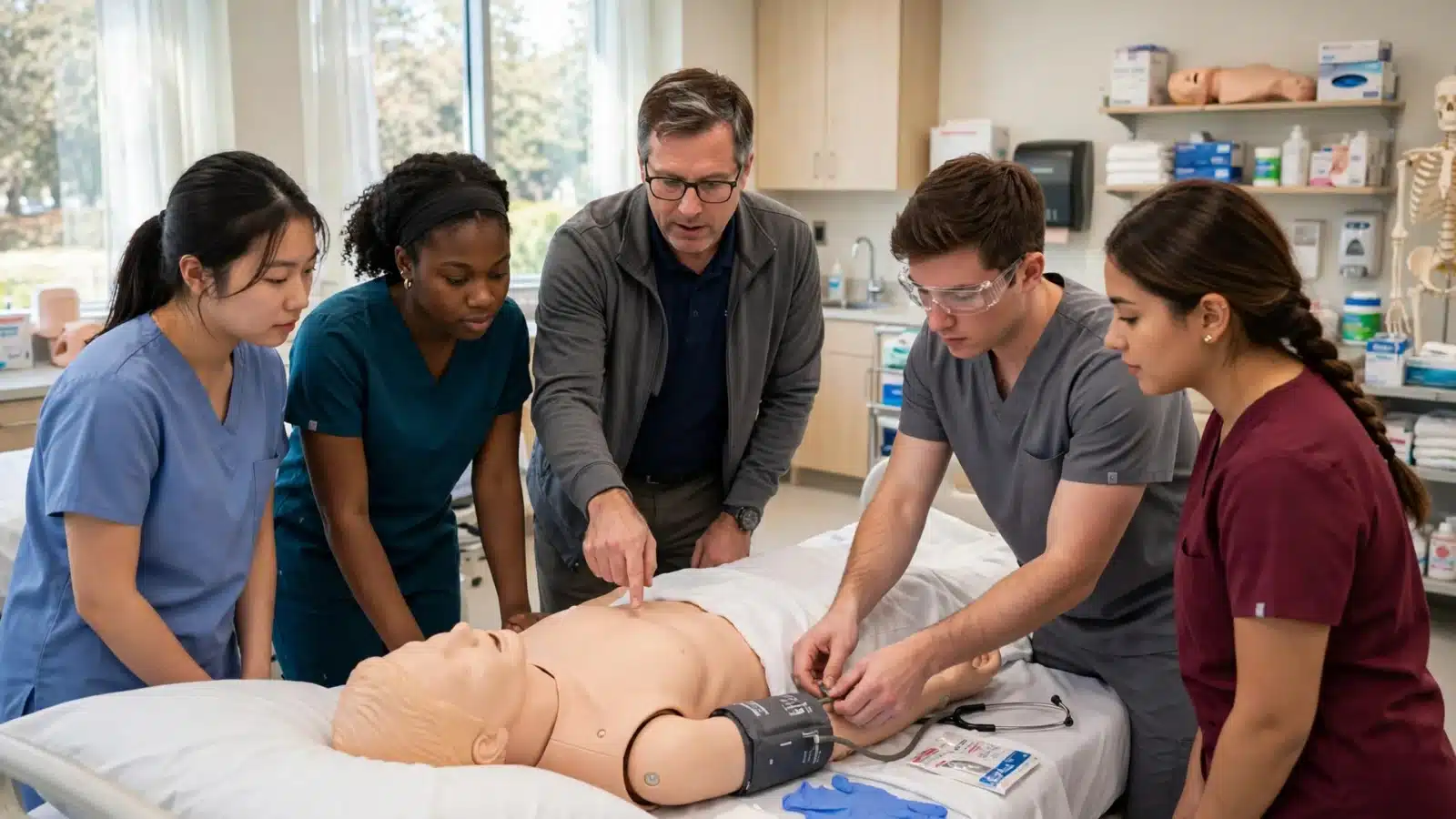
The CNA program is built around the real work of a nursing assistant. RIAHS describes the program’s focus as providing basic patient care, monitoring vitals, and supporting nursing staff in hospitals, clinics, and long-term care facilities. In practice, that means your training will revolve around these areas:
- Basic patient care — helping patients with eating, bathing, dressing, and moving safely around the ward.
- Vital signs monitoring — measuring blood pressure, pulse, temperature, and breathing, and recording them accurately.
- Hygiene and infection control — clean technique, safe handling of bedding and equipment, and protecting patients from infection.
- Supporting nursing staff — preparing patients for procedures, keeping wards organised, and reporting changes in a patient’s condition promptly.
- Patient communication — speaking to patients and families with patience and respect, especially when they are frightened or in pain.
- Record-keeping — the unglamorous backbone of safe care: accurate notes, correct charts, and proper handover between shifts.
A note of honesty: RIAHS does not publish a subject-by-subject syllabus for CNA on its programs page, so this guide describes the program’s training areas rather than inventing a semester-wise subject list. Ask the institute for the current syllabus when you apply — syllabuses are set within the PMF framework and can be updated.
CNA vs LHV vs CMW: What Is the Difference?
These three Category C programs are often confused, so here is the short version. The CNA is a one-year program in general hospital-based patient care: vitals, bedside assistance, and supporting nurses. The CMW (Community Midwife) is an 18-month, female-only program focused on pregnancy, birth, and newborn care in community settings. The LHV (Lady Health Visitor) is a two-year, female-only program with a broader maternal and child health visiting role across Punjab. If you want general ward work and the fastest route into a hospital, CNA fits best; if your heart is set on mothers and babies, look at CMW or LHV instead. You can compare all three on the programs page, and the LHV and CMW guides are on the RIAHS blog.
Career Scope of a CNA in Pakistan
What is the scope of the CNA course in Pakistan?
The scope of a CNA in Pakistan is rooted in a simple reality: hospitals, clinics, and long-term care facilities always need trained hands at the bedside. Doctors diagnose and nurses manage care plans, but the hour-by-hour work — checking vitals, helping a recovering patient walk to the bathroom, keeping a ward clean and calm — falls to nursing assistants. That work does not disappear when budgets tighten; if anything, busy wards lean on good CNAs more.
A CNA’s workplace is the hospital ward, the clinic, or the long-term care facility — not the community home-visit route of a midwife. Over time, an experienced CNA becomes the staff member new nurses rely on: the one who knows the ward’s routines, notices a patient deteriorating early, and keeps families reassured. That experience can also become a stepping stone — many CNAs go on to further nursing or allied-health study once they are earning and have seen the hospital world from the inside.
We are not quoting a salary figure here, because pay depends on the employer, the setting, and the region — any article that gives you one exact number for every CNA in Pakistan is guessing.
How to Apply at RIAHS
Applying follows the same straightforward path as the institute’s other programs. First, browse the programs and check that you meet the CNA eligibility above. Then fill in the application form on the RIAHS admissions page or visit the campus in person — Opposite Sohrab Factory, Begum Kot, Sheikhupura Road, Shahdara, Lahore — bringing your original documents for verification. Once your application is reviewed and merit is finalised, the admissions team will call you to confirm your seat and complete enrollment.
On fees: the admissions page states plainly that the fee structure is available on a campus visit or WhatsApp inquiry, and that an installment plan is available — ask at the time of enrollment. That is why this guide gives no fee number: the honest answer is to ask the institute directly, and you should be wary of any site that quotes a CNA fee without a source.
The admissions team is available Monday to Saturday, 9:00 AM to 7:00 PM, and can be reached on 03464542144.
Frequently Asked Questions
How many years is the CNA course?
The CNA course at RIAHS is 1 year — the shortest program among the institute’s Category C offerings. Do not confuse it with the 18-month CMW course or the two-year LHV course.
Can I apply for CNA after Matric with arts subjects?
Yes. Category C programs, including CNA, accept Matric from any group, provided you have at least 45% marks. You do not need Matric (Science) for this program.
Is the CNA course only for girls?
No gender restriction is listed for CNA on the RIAHS admissions page. The female-only rule applies to LHV and CMW, not to CNA.
What is the difference between CNA and nursing?
A CNA provides basic, hands-on patient care and supports nursing staff; a nurse plans, manages, and is accountable for patient care. CNA training takes one year at RIAHS, while nursing qualifications take longer and carry a wider scope of practice. Many CNAs later move into further nursing study.
Does RIAHS offer a fee installment plan for CNA?
Yes — the admissions page states that an easy installment plan is available for all programs, with details to be asked about at enrollment. The exact fee structure is shared on a campus visit or WhatsApp inquiry.
Where can a CNA work after completing the course?
CNAs work in hospitals, clinics, and long-term care facilities, providing basic patient care, monitoring vitals, and supporting nursing staff.
Is there an age limit for the CNA course?
No age limit is stated for CNA on the RIAHS admissions page. The 15–25 age range you may see quoted applies to Category A programs only; Category C programs, including CNA, list no age restriction.
Is the CNA course hard?
The course is designed for students coming straight from Matric, so it does not assume advanced science background. The challenge is practical rather than academic: reliability, hygiene discipline, careful observation, and treating patients with patience on long ward days. Students who are comfortable with hands-on work usually settle in quickly.
Can I apply for CNA without Matric?
No. Matric with at least 45% marks is the minimum entry requirement for CNA at RIAHS, as it is for all Category C programs. Advertisements for no-diploma CNA routes abroad do not apply to the PMF-affiliated route in Pakistan.
Sources: RIAHS programs page (https://raviiahs.com/programs/) and admissions page (https://raviiahs.com/admissions/), verified 2026-11-03; Punjab Medical Faculty official site (https://pmfpunjab.edu.pk/). Fee figures, admission dates, and salary figures are intentionally not stated where RIAHS does not publish them.