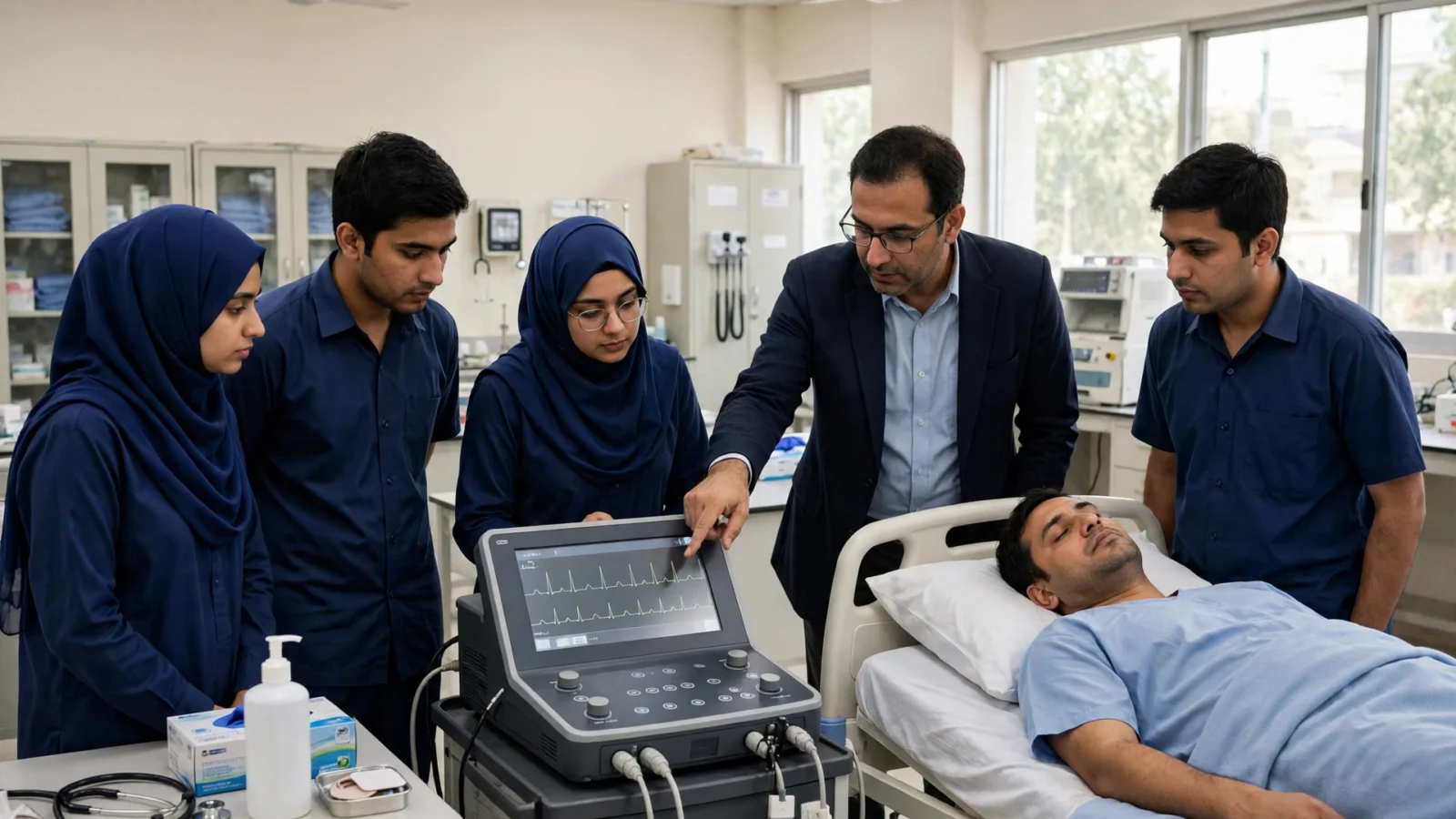
Picture a cardiology ward on a busy morning. A patient arrives with chest discomfort, a doctor orders an ECG, and within minutes a tracing appears on a screen — a wavy line that tells the doctor more in ten seconds than a long conversation could. Someone had to place those electrodes correctly, run the machine properly, and hand over a clean, readable result. That someone is a cardiac technician. The cardiac technician course in Pakistan is how you train for exactly that role, and at RIAHS it is one of the Category A programs in the institute’s New Scheme of Studies group.
This guide covers the course honestly: what it is, how long it takes, who can apply, what you will actually learn, and where it can take you afterwards. Every fact about RIAHS here comes from the institute’s own programs and admissions pages, verified today. Where a detail depends on the current admission cycle — fees, dates, merit lists — we say so plainly instead of guessing.

Key Takeaways
- The Cardiac Technician course at RIAHS is a 2-year program.
- It is a Category A — New Scheme of Studies program, equal to F.Sc (Medical Technology Group).
- Eligibility: Matric (Science) — Biology, Chemistry, Physics — with a minimum of 45% marks, and age 15–25 years at admission.
- Training covers operating ECG machines and cardiac monitors and assisting cardiologists in diagnostic and interventional cardiac procedures.
- Cardiac technicians work in hospital cardiology departments, cardiac care units, and diagnostic centres.
- Fee details are shared on a campus visit or WhatsApp inquiry — no fee figure is published on the admissions page, and none is claimed here.
Table of Contents
- What Is a Cardiac Technician Course?
- How Long Is the Cardiac Technician Course?
- Who Can Apply for the Cardiac Technician Course?
- What Subjects Will You Study?
- Cardiac Technician vs ECG Technician: What Is the Difference?
- Career Scope of a Cardiac Technician in Pakistan
- How to Apply at RIAHS
- Frequently Asked Questions
What Is a Cardiac Technician Course?
A cardiac technician is the healthcare worker who handles the machines that watch the heart. The best-known of these is the ECG machine, which records the heart’s electrical activity as a tracing. Then there are cardiac monitors, which keep an eye on a patient’s heart rhythm continuously, often in a cardiac care unit where a change in rhythm needs to be spotted fast. The technician’s job is to prepare the patient, place electrodes and leads correctly, run the test, recognise when a tracing is poor quality and needs repeating, and make sure the result reaches the doctor in usable form.
It sounds simple until you try it. A loose electrode, a patient who has just moved, or a lead placed one position off can all produce a tracing that misleads rather than helps. Precision matters here in a very direct way: the doctor’s next decision may rest on what your machine recorded. That is why this is skilled, responsible work, not just switching a machine on and off.
At the Ravi Institute of Allied Health Sciences (RIAHS) in Shahdara, Lahore, the Cardiac Technician program sits in Category A — the New Scheme of Studies group, equal to F.Sc (Medical Technology Group). RIAHS is a PMF-affiliated institute, so its programs run under the Punjab Medical Faculty framework. You can compare all the programs on the RIAHS programs page, and the official PMF site is pmfpunjab.edu.pk.
How Long Is the Cardiac Technician Course?
How many years is the cardiac technician course?
The cardiac technician course at RIAHS is 2 years long. That is the standard length for every Category A program at the institute — Dispenser, MLT, Radiography, Operation Theater Technician, and the rest of the group all run for two years. Two years gives you time to move from the basics — how the heart works, how an ECG machine is set up, how a patient is prepared — to confident, independent work with real equipment in a clinical setting.
Exact class schedules and start dates change from one admission cycle to the next. RIAHS announces current dates on its Notice Board, so check there — or ask the admissions team directly — rather than relying on a date you read in an old article, including this one.
Who Can Apply for the Cardiac Technician Course?
What is the eligibility for the cardiac technician course in Pakistan?
To apply for the cardiac technician course at RIAHS, you need Matric (Science) — Biology, Chemistry, and Physics — with a minimum of 45% marks in your board examination, and you must be aged 15–25 years at the time of admission. Selection is on a merit basis, with higher Matric marks prioritised and seats limited. These are the Category A requirements, and they apply across the group, not just to this one program.
| Requirement | Detail (RIAHS) |
|---|---|
| Qualification | Matric (Science) — Biology, Chemistry, Physics |
| Minimum marks | 45% in board examination |
| Age | 15–25 years at time of admission |
| Duration | 2 years |
| Category | Category A — New Scheme, equal to F.Sc (Medical Technology Group) |
| Selection | Merit basis; seats limited |
What documents do I need to apply?
RIAHS asks for your CNIC or B-Form (original plus a copy), your Matric certificate (original plus two copies), and four passport-size photographs. Bring originals for verification and keep copies ready — the admissions page lists these documents for Category A programs.
Can I apply for the cardiac technician course after 12th class?
Yes — and you do not need to wait for F.Sc at all. The entry qualification is Matric (Science), so the course is open to you straight after Matric. If you have already completed F.Sc, you can still apply, provided you meet the age and marks requirements.
Is there an age limit for the cardiac technician course?
Yes. Category A programs require applicants to be aged 15–25 years at the time of admission. If you are outside that range, check with the admissions team — they can confirm whether any exception applies, but do not assume one.
What Subjects Will You Study?
RIAHS describes the Cardiac Technician program’s focus as operating ECG machines and cardiac monitors and assisting cardiologists in diagnostic and interventional cardiac procedures. In practice, that training breaks down into these areas:
- ECG recording — how the heart’s electrical activity is captured, how electrodes and leads are placed, and how to produce a clean, readable tracing.
- Cardiac monitoring — continuous heart-rhythm monitoring in wards and cardiac care units, and recognising when a rhythm needs urgent attention.
- Cardiac procedures support — assisting cardiologists during diagnostic and interventional procedures, including preparing equipment and the patient.
- Patient preparation and care — explaining a test to a nervous patient, positioning them correctly, and keeping them comfortable and safe during the test.
- Equipment handling and safety — correct use, basic maintenance, and safe operation of ECG machines and monitors, plus infection-control basics.
- Recording and reporting — labelling, storing, and handing over results accurately so the doctor can act on them without delay.
A note of honesty: RIAHS does not publish a subject-by-subject syllabus for Cardiac Technician on its programs page, so the list above describes the program’s training areas rather than a semester-by-semester subject list. If you need the detailed syllabus, ask the admissions team — they can share the current one.
Cardiac Technician vs ECG Technician: What Is the Difference?
People often use these two titles as if they mean the same thing, and there is real overlap — both work with ECG machines. The difference is breadth. An ECG technician’s work centres mainly on recording ECGs. A cardiac technician’s training is broader: ECG work plus cardiac monitoring, plus assisting in diagnostic and interventional cardiac procedures alongside cardiologists. At RIAHS, the Cardiac Technician program is a two-year, PMF-affiliated Category A program, equal to F.Sc (Medical Technology Group) — a full program, not a short ECG-only certificate. If you are offered a short ECG course elsewhere, it may be useful, but it is not the same qualification — check what it actually awards before you enrol.
That matters when comparing options: check the duration, the awarding body, and exactly which procedures the training covers, rather than judging by the job title alone.
Career Scope of a Cardiac Technician in Pakistan
What is the scope of the cardiac technician course in Pakistan?
Heart disease is one of the most common reasons people end up in a hospital, and every cardiac patient passes through a technician’s hands at some point — an ECG on arrival, a monitor in the ward, a test before a procedure. Hospitals, cardiac care units, and diagnostic centres all need people who can run this equipment reliably, and that need does not depend on one city or one hospital. A cardiac technician’s work is needed wherever cardiology is practised.
With experience, a cardiac technician becomes the person a cardiology department trusts with its busiest machines: the one who gets a clean tracing from a restless patient, keeps monitors running through a long shift, and prepares everything a cardiologist needs before a procedure starts. That reliability is what turns a new graduate into a valued member of a cardiac team.
We are not quoting a salary figure here, because pay depends on the employer, the setting, and the region — any article that gives you one exact number for every cardiac technician in Pakistan is guessing. The same applies to fees: ask RIAHS directly rather than trusting an unsourced number online.
How to Apply at RIAHS
Applying follows the same straightforward path as the institute’s other programs. First, browse the programs and check that you meet the cardiac technician eligibility above. Then fill in the application form on the RIAHS admissions page or visit the campus in person — Opposite Sohrab Factory, Begum Kot, Sheikhupura Road, Shahdara, Lahore — bringing your original documents for verification. Once your application is reviewed and merit is finalised, the admissions team will call you to confirm your seat and complete enrolment.
On fees: the admissions page states plainly that the fee structure is available on a campus visit or WhatsApp inquiry, and that an installment plan is available — ask at the time of enrollment. That is why this guide gives no fee number: the honest answer is to ask the institute directly, and you should be wary of any site that quotes a cardiac technician fee without a source.
The admissions team is available Monday to Saturday, 9:00 AM to 7:00 PM, and can be reached on 03464542144.
Frequently Asked Questions
How many years is the cardiac technician course?
The cardiac technician course at RIAHS is 2 years — the standard length for all Category A programs at the institute.
What is the eligibility for the cardiac technician course?
Matric (Science) with Biology, Chemistry, and Physics, at least 45% marks, and age 15–25 years at admission. Selection is merit-based.
Can I do a cardiac technician course after 10th class?
Yes. Matric is the 10th class, and Matric (Science) with 45% marks is the entry qualification for the cardiac technician course at RIAHS. You do not need F.Sc first.
Is there an age limit for the cardiac technician course?
Yes. Category A programs require applicants to be aged 15–25 years at the time of admission.
What subjects are in the cardiac technician course?
The program’s core training areas are ECG recording, cardiac monitoring, assisting in diagnostic and interventional cardiac procedures, patient preparation, equipment handling and safety, and accurate recording and reporting. RIAHS does not publish a semester-wise syllabus on its programs page, so ask the admissions team for the detailed syllabus.
What is the difference between a cardiac technician and an ECG technician?
An ECG technician’s work centres mainly on recording ECGs. A cardiac technician’s training is broader: ECG work plus cardiac monitoring plus assisting in diagnostic and interventional cardiac procedures.
Where can a cardiac technician work after completing the course?
Cardiac technicians work in hospital cardiology departments, cardiac care units, and diagnostic centres.
Does RIAHS offer a fee installment plan for the cardiac technician course?
Yes — the admissions page states that an easy installment plan is available for all programs, with details shared on a campus visit or WhatsApp inquiry.
Is the cardiac technician course hard?
The course is designed for students coming from Matric (Science), so it builds on school science rather than assuming advanced knowledge. The challenging parts are practical: placing leads correctly, producing clean tracings, and staying calm and precise with patients who are unwell or anxious.
Sources: RIAHS programs page (https://raviiahs.com/programs/) and admissions page (https://raviiahs.com/admissions/). RIAHS Notice Board (https://raviiahs.com/notice-board/) and Punjab Medical Faculty (https://pmfpunjab.edu.pk/).