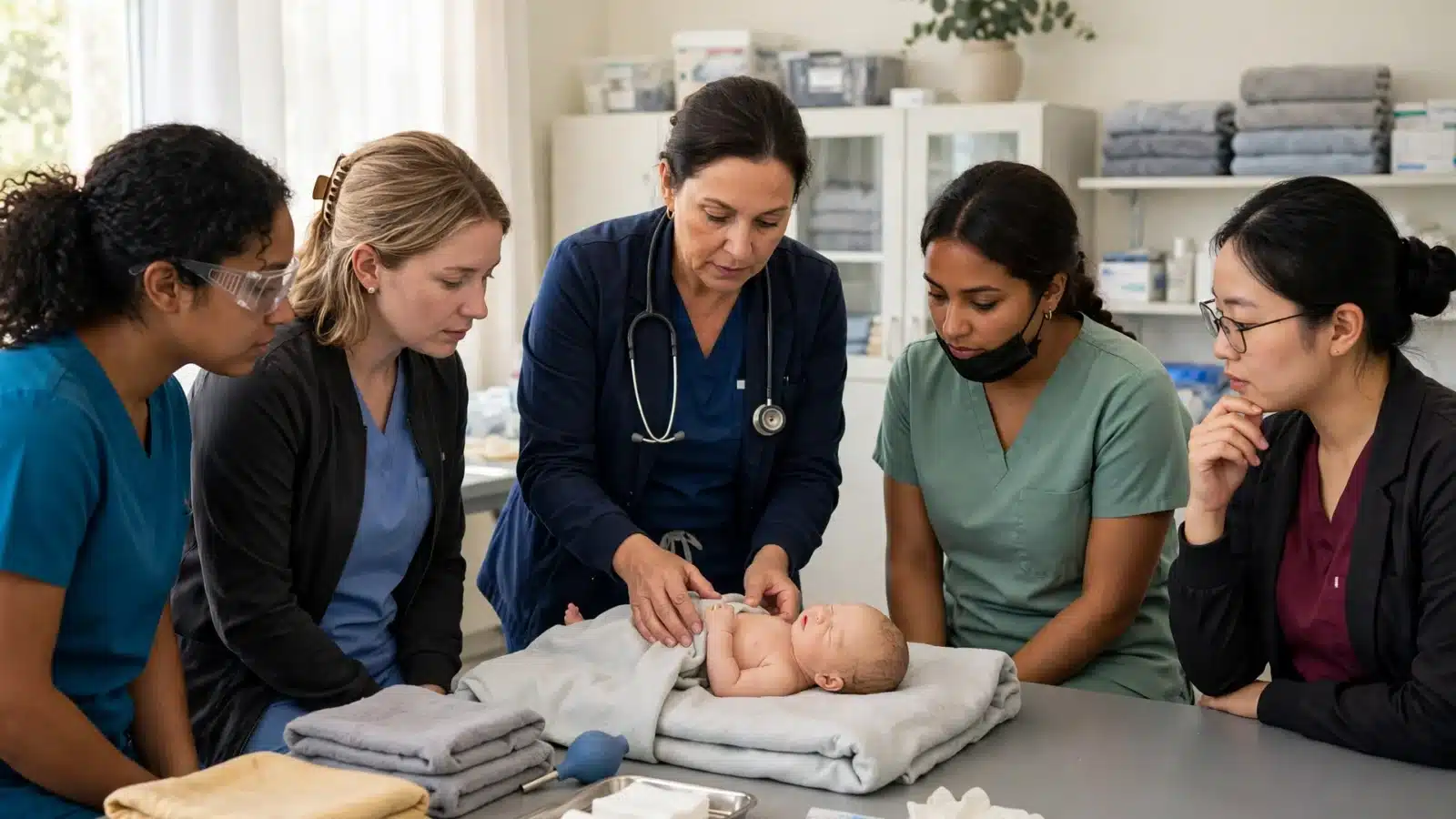
If you have ever watched a midwife calmly guide a family through a pregnancy — answering worried questions, checking on the mother, and then holding a healthy newborn — you already understand why this work matters so much. In villages and small towns across Punjab, where a hospital can be miles away, a trained community midwife is often the first, and sometimes the only, healthcare professional a mother ever meets. The CMW course in Pakistan trains you for exactly that role: skilled, trusted, community-based maternal care.
In this guide, we walk through the CMW course honestly — what it is, how long it takes, who can apply, what you will study, and where it can take you afterwards. Everything about RIAHS here comes from the institute’s own programs and admissions pages, and we have not guessed at any fee, date, or deadline: where a detail depends on the current admission cycle, we say so plainly.
Key Takeaways
- The CMW (Community Midwife) course at RIAHS is an 18-month program.
- It is a Category C program under the Punjab Medical Faculty (PMF) affiliation, and admission is for female candidates only.
- Eligibility: Matric (any group) with a minimum of 45% marks, on a merit basis.
- CMWs provide skilled birth attendance, antenatal care, and postnatal support in community settings across Punjab.
- Fee details are shared on a campus visit or WhatsApp inquiry — no fee figure is published on the admissions page, and none is claimed here.
Table of Contents
- What Is a CMW Course?
- How Long Is the CMW Course?
- Who Can Apply for the CMW Course?
- What Subjects Will You Study?
- CMW vs LHV vs CNA: What Is the Difference?
- Career Scope of a Community Midwife in Pakistan
- How to Apply at RIAHS
- Frequently Asked Questions
What Is a CMW Course?
A Community Midwife (CMW) is a trained healthcare worker who looks after mothers and newborns in their own communities — at home, in a basic health unit, or in a small local clinic. The word “community” is doing real work here: unlike a hospital-based nurse or doctor, a CMW’s workplace is the neighbourhood itself. She visits families, follows a pregnancy from the early months through delivery and beyond, and knows when a case needs to be referred to a hospital.
At the Ravi Institute of Allied Health Sciences (RIAHS) in Shahdara, Lahore, the CMW program sits in Category C — the institute’s “Other Programs” group — alongside LHV, CNA, and the B-Category Pharmacy Technician program. RIAHS is a PMF-affiliated institute, which means its programs run under the Punjab Medical Faculty framework. You can read more about the full program list on the RIAHS programs page, and the official PMF site is pmfpunjab.edu.pk.
How Long Is the CMW Course?
Is the CMW course 18 months long?
Yes. At RIAHS, the CMW — Community Midwife program is an 18-month program. That is shorter than the institute’s two-year Category A and Category B programs, and longer than the one-year CNA program. In practical terms, 18 months is long enough to cover the classroom foundations and the hands-on community training this role genuinely needs, without asking you to commit to a full two years before you start working.
Exact class schedules and start dates change from one admission cycle to the next. RIAHS announces current dates on its Notice Board, so check there — or ask the admissions team directly — rather than relying on a date you read in an old article, including this one.
Who Can Apply for the CMW Course?
What is the eligibility for the CMW course in Pakistan?
To apply for the CMW course at RIAHS, you need Matric from any group with a minimum of 45% marks in your board examination. Unlike the Category A programs, which require Matric (Science) with Biology, Chemistry, and Physics, Category C programs accept Matric from any group — so students from arts and general streams are not shut out. Admission is for female candidates only, and selection is on a merit basis, with higher Matric marks prioritised and seats limited.
| Requirement | Detail (RIAHS) |
|---|---|
| Qualification | Matric (any group) |
| Minimum marks | 45% in board examination |
| Gender | Female candidates only |
| Duration | 18 months |
| Category | Category C — Other Programs |
| Selection | Merit basis; seats limited |
What documents do I need to apply?
RIAHS asks for your CNIC or B-Form (original plus a copy), your Matric certificate (original plus two copies), and four recent passport-size photographs. Keep originals ready for verification when you visit the campus or submit your application — it saves a second trip.
What Subjects Will You Study?
The CMW program is built around the real work of a community midwife. RIAHS describes the program’s focus as skilled birth attendance, antenatal care, and postnatal support delivered in community settings. In practice, that means your training will revolve around these areas:
- Antenatal care — following a pregnancy, checking the mother’s health, and spotting warning signs early.
- Skilled birth attendance — safe delivery practices and immediate newborn care.
- Postnatal support — caring for the mother and baby in the days and weeks after birth, including breastfeeding guidance.
- Family planning counselling — the kind of honest, private conversations families actually need, handled with care.
- Community health and referral — knowing your limits, recognising danger signs, and referring a mother to hospital care in time.
- Record-keeping and hygiene — the unglamorous backbone of safe practice: clean technique, accurate notes, and follow-up visits.
A note of honesty: RIAHS does not publish a subject-by-subject syllabus for CMW on its programs page, so this guide describes the program’s training areas rather than inventing a semester-wise subject list. Ask the institute for the current syllabus when you apply — syllabuses are set within the PMF framework and can be updated.
CMW vs LHV vs CNA: What Is the Difference?
These three Category C programs are often confused, so here is the short version. The CMW is the community midwife: 18 months, focused on pregnancy, birth, and newborn care in community settings. The LHV (Lady Health Visitor) is a two-year program with a broader maternal and child health role — community visits, family planning counselling, and preventive healthcare across Punjab. The CNA (Certified Nursing Assistant) is a one-year program in basic patient care: monitoring vitals and supporting nursing staff in hospitals and clinics, rather than midwifery specifically. If your heart is set on mothers and babies, CMW is the direct route; if you want broader community health visiting, look at LHV; if you want general hospital-based patient care, CNA fits better. You can compare all three on the programs page.
Career Scope of a Community Midwife in Pakistan
What is the scope of the CMW course in Pakistan?
The scope of a community midwife in Pakistan is rooted in a simple reality: most births in rural and low-income communities still happen far from a big hospital, and trained midwives close that gap. A CMW works in community settings across Punjab — visiting families at home, supporting basic health units and small clinics, and building the kind of trust that makes mothers actually seek care early instead of waiting until there is an emergency.
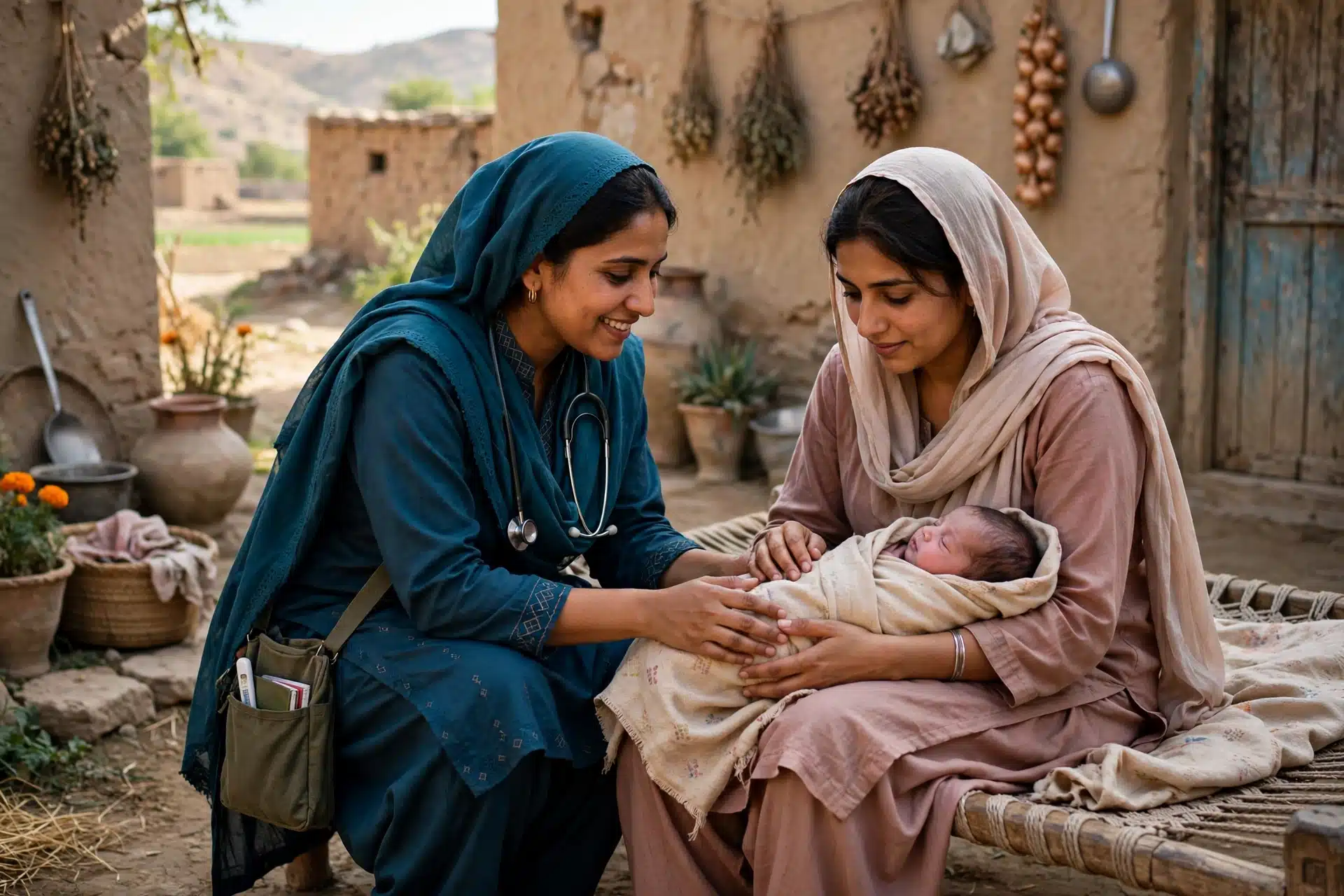
That trust is the career. Families remember the midwife who checked on them, explained things in plain language, and came back for the follow-up visit. Over time, an experienced CMW becomes a known, respected health figure in her area, and that reputation opens doors: continued work in community health programs, roles supporting maternal and child health services, and further study or specialisation as her career grows. We are not quoting a salary figure here, because pay depends on the employer, the setting, and the region — any article that gives you one exact number for every CMW in Pakistan is guessing.
What we can say with confidence is that maternal and newborn care is not a shrinking field. As long as communities need safe births and honest health advice close to home, trained community midwives will be needed.
How to Apply at RIAHS
Applying follows the same straightforward path as the institute’s other programs. First, browse the programs and check that you meet the CMW eligibility above. Then fill in the application form on the RIAHS admissions page or visit the campus in person — Opposite Sohrab Factory, Begum Kot, Sheikhupura Road, Shahdara, Lahore — bringing your original documents for verification. Once your application is reviewed and merit is finalised, the admissions team will call you to confirm your seat and complete enrollment.
On fees: the admissions page states plainly that the fee structure is available on a campus visit or WhatsApp inquiry, and that an installment plan is available — ask at the time of enrollment. That is why this guide gives no fee number: the honest answer is to ask the institute directly, and you should be wary of any site that quotes a CMW fee without a source.
The admissions team is available Monday to Saturday, 9:00 AM to 7:00 PM, and can be reached on 03464542144.
Frequently Asked Questions
Is the CMW course only for girls?
Yes — at RIAHS, the CMW program (like LHV) is for female candidates only, as stated on the admissions page. This reflects the nature of the work: community midwives provide intimate maternal care in family homes, where female providers are expected and trusted.
Can I apply for CMW after Matric with arts subjects?
Yes. Category C programs, including CMW, accept Matric from any group, provided you have at least 45% marks. You do not need Matric (Science) for this program.
How many years is the CMW course?
The CMW course at RIAHS is 18 months — one and a half years — not a two-year program. Do not confuse it with the two-year LHV program.
What is the difference between CMW and LHV?
CMW is an 18-month program focused on community midwifery: skilled birth attendance, antenatal, and postnatal care. LHV is a two-year program with a broader maternal and child health visiting role. Both are female-only Category C programs at RIAHS.
Does RIAHS offer a fee installment plan for CMW?
Yes — the admissions page states that an easy installment plan is available for all programs, with details to be asked about at enrollment. The exact fee structure is shared on a campus visit or WhatsApp inquiry.
Where can a CMW work after completing the course?
Community midwives work in community settings across Punjab: home visits, basic health units, and small clinics, supporting maternal and newborn care and referring complicated cases to hospitals when needed.
Sources: RIAHS programs page (https://raviiahs.com/programs/) and admissions page (https://raviiahs.com/admissions/), verified 2026-11-02; Punjab Medical Faculty official site (https://pmfpunjab.edu.pk/). Fee figures, admission dates, and salary figures are intentionally not stated where RIAHS does not publish them.