If your child is due a vaccine and you are not sure where to go, the answer is simpler than most parents expect. A vaccination centre in Pakistan is usually the EPI centre attached to the nearest government health facility — a basic health unit, a rural health centre, or a tehsil or district hospital. The vaccines there are free, the schedule is the same everywhere in the country, and you do not need an appointment or a referral to walk in. This guide explains how to find your nearest centre, what its timings are, what to bring, and what actually happens when you get there.
The most important thing to know before you set out is that routine childhood vaccination in Pakistan runs through one national programme: the Expanded Programme on Immunization (EPI), run by the Federal Directorate of Immunization. Every EPI centre follows the same schedule — the six-visit chart from birth to 15 months — and every dose is recorded on the same card. So the centre nearest your home is the right centre, whichever one it is.
Key Takeaways
- A vaccination centre in Pakistan is usually an EPI centre at a government health facility — a basic health unit, rural health centre, or tehsil/district hospital.
- All routine EPI vaccines are free at government centres — you pay nothing for the vaccines themselves.
- To find your nearest centre, call the Sehat Tahaffuz helpline 1166, check the centre lists on epi.gov.pk, or ask at your local basic health unit or your Lady Health Worker.
- Timings vary from centre to centre, and some centres vaccinate only on certain days — check before you travel.
- Bring three things: your child’s EPI card, the B-Form or birth certificate, and your own CNIC.
- After the jab, stay at the centre for about 15 to 30 minutes so staff can watch for any immediate reaction.
- A missed dose is not a disaster — go to the centre as soon as you can and the vaccinator will catch the schedule up.
Table of Contents
- What Is a Vaccination Centre in Pakistan?
- How to Find a Vaccination Centre Near Me
- Types of Vaccination Centres: Government, Private, and Outreach
- Vaccination Centre Timings in Pakistan
- What to Bring to a Vaccination Centre
- What Happens at a Vaccination Visit
- Are Vaccines Free at Vaccination Centres in Pakistan?
- What If You Miss a Dose or Lose the Card?
- Vaccination Centres for Adults and Pregnant Women
- Frequently Asked Questions
What Is a Vaccination Centre in Pakistan?
What is a vaccination centre in Pakistan?
A vaccination centre in Pakistan is a health facility where routine vaccines are given under the national Expanded Programme on Immunization (EPI). In practice, that means the EPI centre inside a government health facility — most commonly a basic health unit (BHU), a rural health centre (RHC), a tehsil headquarters hospital (THQ), or a district headquarters hospital (DHQ). There are thousands of these centres across the country, and they all follow the same national schedule: six visits from birth to 15 months, with 19 doses protecting against 12 diseases. The full schedule is laid out in our guide to the immunization schedule in Pakistan.
The word “centre” can be confusing, because it has been used for different things at different times. During the COVID-19 campaign, large temporary mass vaccination centres were set up in places like Expo Centres — those were a separate, temporary setup for the COVID vaccine, not the routine childhood programme. When this guide talks about a vaccination centre, it means the everyday EPI centre where children get their routine vaccines. That is the centre you need for the schedule on your child’s EPI card.
How to Find a Vaccination Centre Near Me
How do I find a vaccination centre near me in Pakistan?
The quickest way to find a vaccination centre near you is to call the Sehat Tahaffuz helpline on 1166 and ask for the nearest EPI centre to your area. The helpline is run by the Federal Directorate of Immunization and can tell you where your nearest centre is. The Federal Directorate of Immunization also publishes lists of EPI centres on its website, epi.gov.pk. The programme keeps a digital registry — Zindagi Mehfooz — but it is the vaccinator’s system, not a parent app: at the centre, the vaccinator enrols your child and the system sends SMS reminders to parents before the next dose.
If you prefer to ask in person, there are three reliable ways to find your centre:
- Ask at your nearest basic health unit or hospital. Even if that facility is not itself an EPI centre, the staff there know which nearby facility is, and on which days it vaccinates.
- Ask your Lady Health Worker or vaccinator. Lady Health Workers visit homes in their area and know the centre days and timings for their neighbourhood — they are often the best local source of this information.
- Search on Google Maps. Searching “EPI centre near me” or “vaccination centre near me” will show nearby government health facilities. Treat the map result as a starting point, not a guarantee: confirm the centre vaccinates children and check its timings before you go, because map listings are not always up to date.
Whichever method you use, do not travel a long distance for a centre you have not confirmed. The nearest centre is almost always the right one — the schedule and the vaccines are the same at every EPI centre, so there is no reason to go further away unless your nearest centre is closed on the day you need it.
Types of Vaccination Centres: Government, Private, and Outreach
Not every place that gives a vaccine is the same kind of centre. It helps to know the difference, because the cost and the record-keeping are not the same.
| Type of centre | Where it is | Cost | What to know |
|---|---|---|---|
| Government EPI centre | BHU, RHC, THQ/DHQ hospital, government dispensary | Free | The standard choice. Same national schedule everywhere; doses recorded on the EPI card. |
| Outreach session | Temporary sessions in villages and neighbourhoods, run by EPI teams | Free | Regular monthly sessions in areas far from a fixed centre; your vaccinator or Lady Health Worker will know the dates. |
| Private hospital or clinic | Registered private hospitals and clinics | Charges apply | Some private facilities are authorised to give EPI vaccines; they may charge a small administrative fee, and their charts sometimes include extra vaccines not in the free EPI programme — ask which vaccines are the EPI ones. |
| Polio campaign team | Door-to-door during national polio campaigns | Free | Campaign doses are extra protection on top of the routine schedule, not a replacement for it — your child still needs the routine EPI visits. |
For most families, the government EPI centre is the right choice: it is free, it follows the national schedule, and it keeps a register of your child’s doses. Outreach sessions matter if you live far from a fixed centre — they are how the programme reaches villages and settlements without a nearby facility, and they run on a regular monthly cycle. If you use a private clinic, the one question to ask is which vaccines on their chart are the free EPI vaccines and which are additional, so you know what you are paying for.
Vaccination Centre Timings in Pakistan
What are the timings of vaccination centres in Pakistan?
There is no single timing that applies to every vaccination centre in Pakistan — timings differ from centre to centre, and many centres vaccinate only on certain days of the week. A centre attached to a busy hospital may vaccinate every working day, while a small basic health unit may hold its EPI session on one or two fixed days a week. That is why the single most useful piece of advice in this guide is to check before you travel: call 1166 or ask your Lady Health Worker for your centre’s days and hours.
A few practical points about timing that hold true across the country:
- Go early in the day. Most EPI centres do their vaccination work during the health facility’s normal working hours, in the morning. Arriving early means the vaccinator is there, the session is running, and you are not turned away because the session has finished.
- Ask about the centre’s vaccination days. If your nearest centre vaccinates only on, say, Tuesdays and Fridays, knowing that saves a wasted trip — and the vaccinator will tell you the next session date.
- Plan around the card, not the calendar. The EPI card gives the due date for the next dose. Try to go on or near that date, but if you cannot, go as soon as you can afterwards — a late dose is far better than a missed one.
- Public holidays close most centres. Government facilities follow the public holiday calendar, so a centre will usually be closed on Eid and other public holidays. If a dose falls due on a holiday, go on the next working day.
What to Bring to a Vaccination Centre
Keep it simple. You need three things, and everything else is optional:
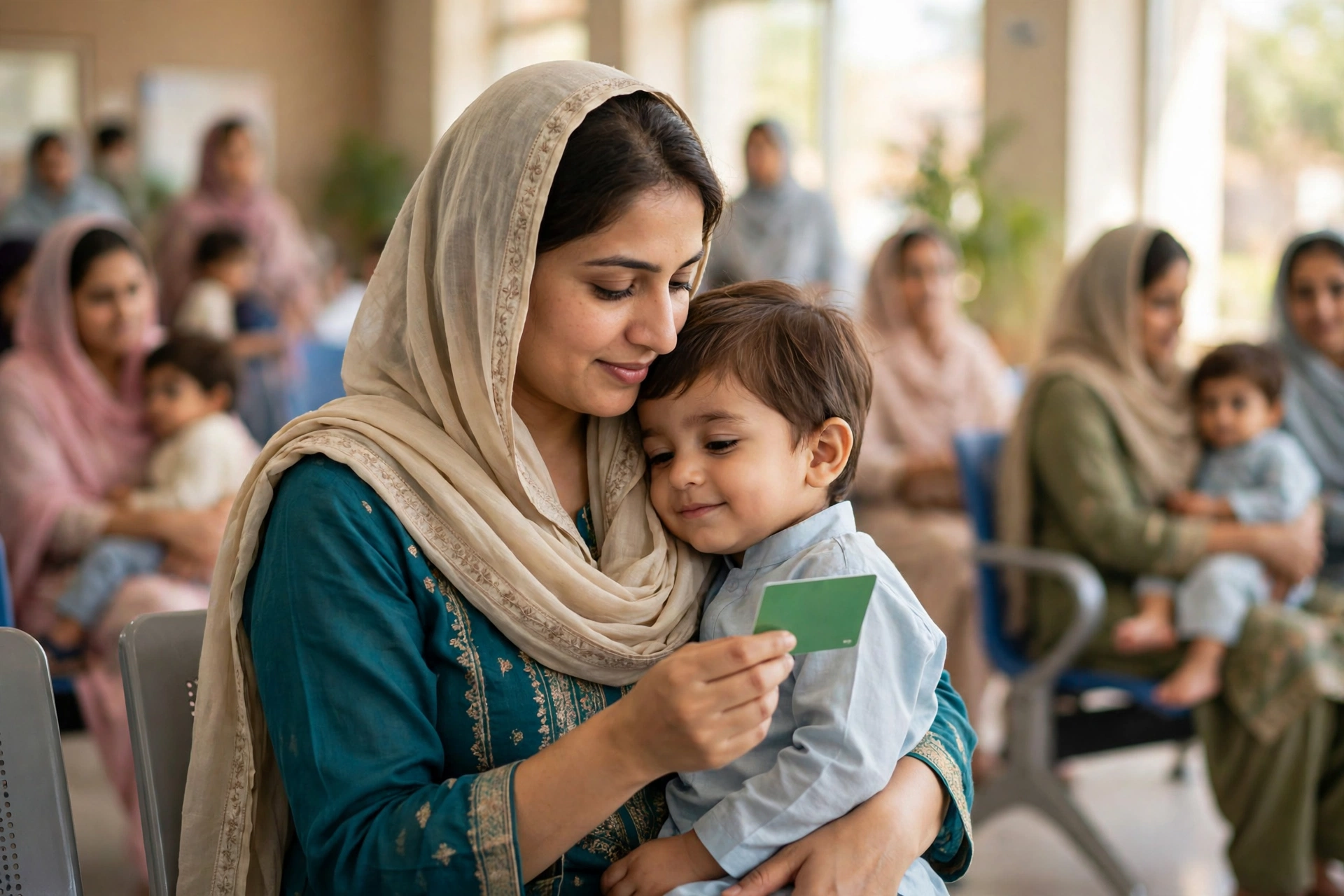
- The EPI card. This is the small booklet the vaccinator fills in at every visit, with the vaccine name and the date. It is the record the vaccinator works from, and it is what the next vaccinator will check. Bring it every single time — without it, the vaccinator has to work out what your child has already had, which wastes time and risks a repeated or missed dose.
- Your child’s B-Form or birth certificate (especially for the first visit). The vaccinator needs the correct date of birth to start the card and to work out which visit your child is due for. For the first visit, the hospital discharge slip also works.
- Your own CNIC. The parent’s CNIC is used for registration, and it is what links your child’s record in the programme’s digital registry.
Two more things that help, though they are not required: dress your baby in clothes that leave the thigh easy to reach, because most infant vaccines are given in the thigh, and feed your baby before you leave home if you can — a hungry or overtired baby cries more and settles more slowly after the injection. If your child is unwell on the day, go anyway and tell the vaccinator: most mild illnesses, like a cold or a low fever, are not a reason to delay, and the vaccinator will decide.
What Happens at a Vaccination Visit
If you have never taken a child to a vaccination centre, here is what a normal visit looks like, step by step:
- Registration. You show the EPI card and your CNIC at the counter, and the staff check which dose your child is due for.
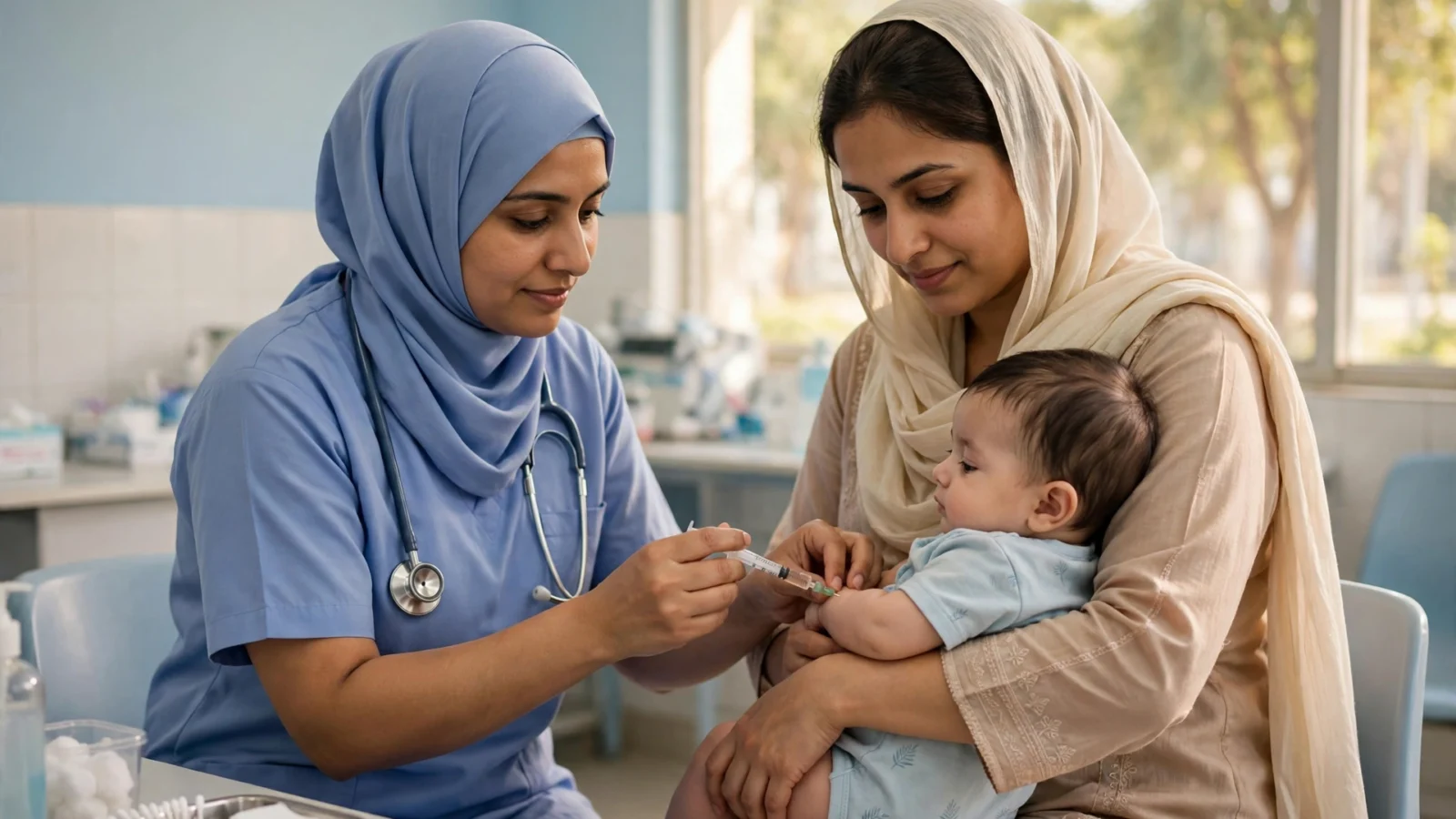
- The vaccine. The vaccinator gives the due vaccine or vaccines — usually an injection in the thigh for babies, sometimes drops by mouth for polio. Most visits involve one or two injections.
- Recording. The vaccinator writes the vaccine name and the date on the EPI card and in the centre’s own register, and tells you the date of the next visit.
- Waiting. You stay at the centre for about 15 to 30 minutes after the injection, so the staff can watch for any immediate reaction. This is standard practice everywhere, not a sign that something is wrong.
- Going home. The vaccinator will tell you what to expect — usually nothing, or a sore leg, a mild fever, or a fussier baby for a day or two — and what to do if you are worried.
The whole visit is usually quick. The waiting time at the end is the longest part, and it is there for your child’s safety, so do not skip it.
Are Vaccines Free at Vaccination Centres in Pakistan?
Are vaccines free at vaccination centres in Pakistan?
Yes. All routine EPI vaccines are free of charge at government vaccination centres across Pakistan. You do not pay for the vaccines themselves, and you do not need to be registered anywhere special to get them. This is the point of the national programme: the vaccines are bought by the government and given free, so that cost is never the reason a child goes unvaccinated.
There are two exceptions worth knowing about. First, private hospitals and clinics charge for the same vaccines, and sometimes add extra vaccines that are not part of the free EPI programme — so if you use a private facility, ask what is on the bill. Second, a centre may charge a small administrative fee in some private settings, but at a government EPI centre the vaccines themselves are free. If anyone at a government centre asks you to pay for an EPI vaccine, that is not how the programme works — you can raise it with the facility’s in-charge or call the 1166 helpline.
What If You Miss a Dose or Lose the Card?
What happens if my child misses a vaccine dose?
Nothing is ruined, and you do not start the schedule over. If your child misses a visit — because of illness, travel, a centre being closed, or simply because life got in the way — take them to the EPI centre as soon as you can, and the vaccinator will give the missed dose and work out the timing for the remaining ones. This is called catch-up vaccination, and it is a normal part of the programme. The important thing is not to wait for the next scheduled visit if you can go sooner, because the longer the gap, the longer your child goes without that protection.
What should I do if I lose my child’s EPI card?
Tell the vaccinator at your next visit. The centre keeps its own register of every dose it has given, so it can check what your child has already had and issue a replacement card. There is no parent app that holds a copy of the card — the record lives in the centre’s own register and in the programme’s digital registry, both kept by the vaccinator. The card matters because it is the only record you carry with you — but losing it is a problem with a fix, not a reason to stop vaccinating.
Vaccination Centres for Adults and Pregnant Women
EPI centres are not only for children. Pregnant women receive tetanus toxoid (TT) doses under the same programme, because tetanus protection passes from the mother to the newborn and protects both of them. The timing depends on whether you have had tetanus shots before, so it is recorded on the mother’s own card, not the baby’s. If you are pregnant and have not had tetanus shots, or you are not sure, ask the vaccinator or the Lady Health Visitor at your first antenatal visit.
Adult vaccines outside the EPI programme — such as the flu vaccine or the hepatitis B vaccine for adults — are generally given at hospitals and private clinics rather than EPI centres, and they are not part of the free routine programme. If you need one of those, ask at your nearest hospital rather than at an EPI centre.
Frequently Asked Questions
How do I find the nearest vaccination centre in Pakistan?
Call the Sehat Tahaffuz helpline on 1166, look at the centre lists on epi.gov.pk, or ask at your nearest basic health unit or your Lady Health Worker. The nearest government EPI centre is almost always the right one, because the schedule and the vaccines are the same everywhere.
Are vaccines free at vaccination centres in Pakistan?
Yes. All routine EPI vaccines are free at government vaccination centres. Private hospitals and clinics charge for the same vaccines, and their charts sometimes include extra vaccines not in the free programme.
What are the timings of EPI vaccination centres?
Timings vary by centre, and many centres vaccinate only on certain days of the week. Most centres work during the health facility’s normal working hours, in the morning. Check your centre’s days and hours before you travel — call 1166 or ask your Lady Health Worker.
What documents do I need to take to a vaccination centre?
Three things: your child’s EPI card, the child’s B-Form or birth certificate (especially for the first visit), and your own CNIC. If you have lost the EPI card, the centre can issue a replacement from its own register.
Do I need an appointment to visit a vaccination centre?
No. Government EPI centres work on a walk-in basis — you do not need an appointment or a referral. Go on the centre’s vaccination day, early in the morning, with the EPI card.
What is the difference between an EPI centre and a private vaccination clinic?
An EPI centre is a government facility that gives the national schedule of vaccines free of charge and records them on the EPI card. A private clinic charges for the same vaccines and may also offer extra vaccines that are not part of the free national programme.
Can my child be vaccinated if they have a cold or fever?
Usually, yes. Most mild illnesses, like a cold or a low fever, are not a reason to delay vaccination. Tell the vaccinator about the illness and they will decide — do not skip the visit on your own.
Are there vaccination centres in Lahore, Karachi, Islamabad, and Rawalpindi?
Yes. Every major city in Pakistan has EPI centres at government hospitals, basic health units, and rural health centres — Lahore, Karachi, Islamabad, and Rawalpindi included. The schedule and the vaccines are the same at every centre, so use the one nearest your home. To find it, call the 1166 helpline or ask at your nearest government health facility.
Where do I get vaccines for Umrah or international travel?
Travel vaccines — for example, the meningococcal vaccine required for Umrah — are given at designated hospitals and travel clinics, not at routine EPI centres. Ask at a major government hospital in your city, or check the requirements with your travel agent or the embassy, before you travel.
What is the 1166 helpline?
1166 is the Sehat Tahaffuz helpline run by the Federal Directorate of Immunization. You can call it to find your nearest EPI centre and ask about the vaccination schedule.
Sources: Federal Directorate of Immunization (epi.gov.pk), Expanded Programme on Immunization schedule, Sehat Tahaffuz helpline 1166. This guide is general information only. Vaccine timings and centre days change — confirm them with your nearest centre or the 1166 helpline before travelling.
At RIAHS, our students learn exactly this kind of community health work. The Public Health Technician programme covers epidemiology, disease prevention, and community health, and our Lady Health Visitor (LHV) and Community Midwife (CMW) programmes train the health workers who run vaccination sessions in communities across Punjab. If you are thinking about a career in allied health, read our guide to the immunization schedule in Pakistan and the paramedical courses in Pakistan — or see the full list of 18 PMF-affiliated programmes at RIAHS. Admissions are merit-based; fee details are available on a campus visit or WhatsApp inquiry at 0346 4542144.