
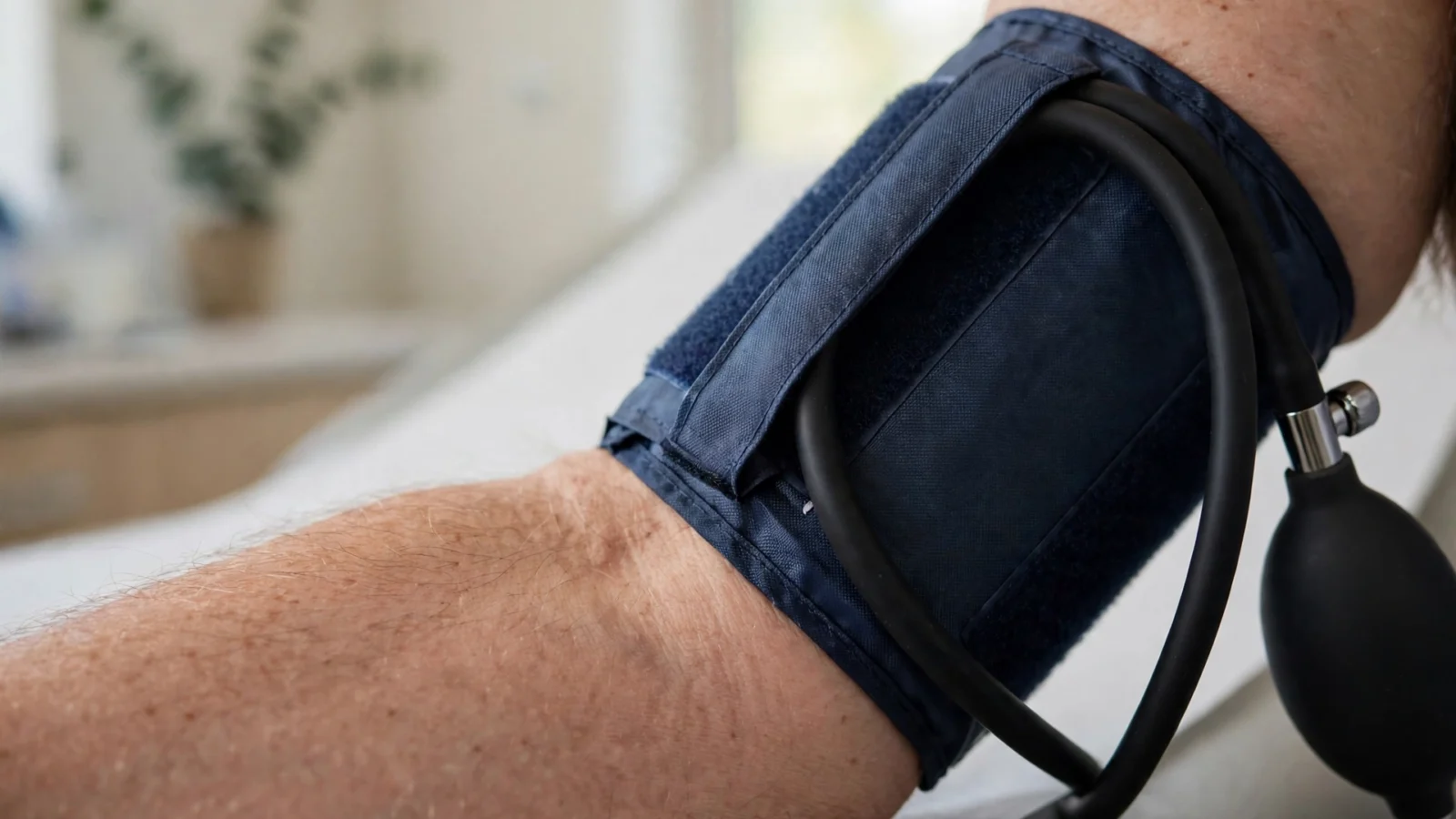
So what is the normal blood pressure, exactly? Normal blood pressure is under 120/80 mmHg — a systolic (top) number below 120 and a diastolic (bottom) number below 80. That is the short answer, and it is the same for every adult under the current American Heart Association and American College of Cardiology guideline. But the number most people remember, 120/80, is not actually normal: a reading of exactly 120/80 is stage 1 hypertension, because the bottom number of 80 already sits in the stage 1 range. This guide explains the full chart, what the two numbers mean, how blood pressure changes with age, how to measure it properly, and when a reading is worth a conversation with your clinician.
Blood pressure is one of the most measured numbers in medicine and one of the most misunderstood. A single reading is not a diagnosis, a number that is a little high on a stressful morning is not a verdict, and a “normal” reading does not mean the number can never change. What matters is the pattern over time — and understanding the ranges is the first step to reading that pattern properly.

Key Takeaways
- Normal blood pressure is under 120/80 mmHg — systolic below 120 and diastolic below 80.
- A reading of 120/80 is stage 1 hypertension, not normal, because the diastolic value of 80 falls in the 80–89 range — when the two numbers fall in different categories, the higher one counts.
- The four adult categories are: normal (under 120/80), elevated (120–129 and under 80), stage 1 (130–139 or 80–89), and stage 2 (140 or higher, or 90 or higher).
- A reading above 180 and/or above 120 is a hypertensive crisis — get emergency care right away if it comes with chest pain, shortness of breath, or trouble speaking.
- Categories are based on the average of at least two readings on at least two occasions — never on one reading alone.
- The same chart applies to all adults — there is no separate “normal by age” column. What changes with age is your risk and your treatment goal, not the categories.
- Technique matters: rest five minutes, sit with your back supported and feet flat, keep the arm supported at heart level, and do not talk during the reading.
Table of Contents
- What Is Normal Blood Pressure? The Full Chart
- What Do the Two Numbers Mean?
- Normal Blood Pressure by Age
- How Blood Pressure Should Be Measured
- What Makes Blood Pressure Go Up or Down?
- Is 120/80 Normal?
- When Is Blood Pressure Dangerous?
- How Often Should You Check Your Blood Pressure?
- What You Can Do About a High Reading
- Frequently Asked Questions
What Is Normal Blood Pressure? The Full Chart
What is a normal blood pressure reading?
A normal blood pressure reading is any reading with a systolic number below 120 and a diastolic number below 80 — written as under 120/80 mmHg. The “mmHg” stands for millimetres of mercury, the unit blood pressure has been measured in since the first cuffs were invented. The chart below is from the American Heart Association and American College of Cardiology guideline — the 2025 update kept the same categories that were set in 2017, so this is the chart your clinician uses today.
| Category | Systolic (top number) | Diastolic (bottom number) | |
|---|---|---|---|
| Normal | Less than 120 | and | Less than 80 |
| Elevated | 120 to 129 | and | Less than 80 |
| Stage 1 hypertension | 130 to 139 | or | 80 to 89 |
| Stage 2 hypertension | 140 or higher | or | 90 or higher |
| Hypertensive crisis | Higher than 180 | and/or | Higher than 120 |
Two details in that table do most of the work. First, the word “and” versus “or”: normal and elevated need both numbers in range, while stage 1 and stage 2 apply when either number reaches the range. Second, when your two numbers fall in different categories, you are assigned to the higher one. A reading of 118/84, for example, is stage 1 — the systolic is normal, but the diastolic of 84 is in the stage 1 range, and the higher category wins. The same rule is why 120/80 is stage 1, not normal, as the next section explains in detail.
One more thing the chart does not show: a category is never assigned from a single reading. The guideline says the numbers should be the average of at least two careful readings taken on at least two separate occasions. A single high reading in a clinic, taken once, is not a diagnosis on its own — it is a reason to measure again, properly.
What Do the Two Numbers Mean?
What do the two blood pressure numbers mean?
Blood pressure is written as two numbers because your heart works in two phases. The top number, systolic pressure, is the pressure in your arteries when your heart beats and pushes blood out. The bottom number, diastolic pressure, is the pressure in your arteries between beats, when your heart rests and fills. The top number is almost always higher, because the push of a heartbeat is stronger than the resting pressure between beats.
Think of it like a pump and a hose. The systolic number tells you how hard the pump pushes; the diastolic number tells you how much pressure stays in the hose while the pump refills. Both matter. A high top number with a normal bottom number is still a high reading — it usually means the arteries have stiffened, which is why isolated systolic hypertension is common in older adults. A high bottom number with a normal top number also matters, because it means the resting pressure in the arteries never drops as low as it should. That is why the chart counts whichever number is higher.
Normal Blood Pressure by Age
What is normal blood pressure by age?
Here is something that surprises most people: the chart above has no age column. Under the AHA/ACC guideline, the same categories apply to every adult, whatever their age. There is no separate “normal for a 60-year-old” or “normal for a 70-year-old” range. A reading of 135/85 is stage 1 hypertension at 30 and stage 1 hypertension at 70 — the category does not change with your birthday.
What does change with age is the context around the number. Blood pressure tends to rise as people get older, because arteries stiffen over time, and the systolic number in particular creeps upward. That is also why the treatment goal is described the way it is: the 2025 AHA/ACC guideline sets a treatment goal of under 130/80 for most adults being treated for high blood pressure, and it extends that goal to adults 65 and older who live independently — while encouraging an under-120 systolic number when it is well tolerated. The guideline also notes that for people with heavy comorbidity or a limited life expectancy, the target is a matter of clinical judgment and personal preference, not a fixed number.
Not every guideline agrees on the older-adult target. The American College of Physicians and the American Academy of Family Physicians take a less strict position for adults 60 and older generally: they recommend starting treatment when the systolic pressure reaches 150 or higher, with a goal of under 150. That disagreement is worth knowing about, because it explains why two clinicians can look at the same reading in an older patient and give different advice. Neither position changes the categories in the chart — it changes the treatment decision.
For children and teenagers, the chart does not apply at all. Paediatric blood pressure is judged against percentile charts that account for the child’s age, sex, and height, and a clinician interprets the result — there is no single “normal” number for a child the way there is for an adult. The same is true in pregnancy, where the thresholds and the management are different and are set by the clinician looking after the pregnancy. If you are checking a child’s or a pregnant person’s blood pressure, do not use the adult chart.
How Blood Pressure Should Be Measured
How should blood pressure be measured correctly?
A blood pressure reading is only as good as the technique behind it. Small mistakes push the number in one direction — almost always upward — and a reading taken badly can look high every single time without the person ever knowing. The American Heart Association’s scientific statement on measurement lays out a method that is worth following exactly, whether the reading is taken in a clinic or at home.
- Prepare for 30 minutes. Avoid caffeine, exercise, and smoking for at least 30 minutes before the reading, and empty your bladder first.
- Rest for five minutes. Sit quietly in a chair, without talking or moving around, for five minutes before the first reading.
- Sit properly. Sit in a chair with your back supported and both feet flat on the floor, legs uncrossed. Sitting on an examination table with no back support does not meet the standard — it can raise both numbers.
- Support the arm at heart level. Rest the arm on a table so the cuff sits level with your heart, with the elbow slightly bent. Do not hold the arm up yourself — that raises the reading — and do not let it hang down, which raises it too. The cuff goes on bare skin, not over a sleeve, and it must be the right size for the arm.
- Stay quiet and still. Neither you nor anyone else should talk during the rest period or during the measurement. Talking alone can add around 10 mmHg to the reading.
- Take two readings, a minute apart. Take at least two readings, about a minute apart, and average them. On a first visit, measure both arms and use the arm with the higher reading from then on — a steady difference of 10 mmHg or more between arms is worth telling your clinician about.
Home monitors can be accurate, but only if they are the right kind and used the right way: an upper-arm cuff device that has been validated, with the correct cuff size, used with the same technique above. Wrist monitors are more sensitive to position and are generally less reliable. And the same rule about repetition applies at home: a single reading is a snapshot, not a verdict — the pattern over days and weeks is what matters, which is why clinicians often ask patients to keep a log of home readings and bring it to the appointment.
What Makes Blood Pressure Go Up or Down?
What causes blood pressure to go up and down?
Blood pressure is not a fixed number — it moves all day. It is usually lower when you sleep, rises when you wake, climbs during exercise or stress, and falls again when you rest. That is normal, and it is one reason a single reading means so little on its own. A reading taken right after you rushed up the stairs, drank a coffee, or sat in a cold waiting room will be higher than one taken after five quiet minutes in a chair.
Over weeks and months, several things push the average up or down. The ones the guidelines talk about most are salt intake, body weight, physical activity, alcohol, and sleep — and smoking, which raises blood pressure with every cigarette. Some medicines can raise blood pressure too, which is why a clinician will ask what you are taking before deciding what a reading means. None of this is a prescription: the point is that blood pressure is a moving target with many inputs, and the number on the screen is the sum of all of them at that moment.
There is also the well-known “white-coat effect”: some people’s blood pressure is higher in a clinic than at home, simply because being measured makes them tense. That is a real, recognised pattern, not an excuse — and it is exactly why the guideline asks for readings on more than one occasion, and often for home readings as well, before a category is assigned.
Is 120/80 Normal?
Is 120/80 normal blood pressure?
No — and this is the most common misunderstanding in the whole topic. A reading of 120/80 mmHg is stage 1 hypertension under the AHA/ACC guideline, not normal. The top number alone (120) would be elevated, but the bottom number (80) falls in the 80–89 range that defines stage 1, and the guideline says that when the two numbers fall in different categories, the person is assigned to the higher one. So 120/80 is stage 1.
Two nearby readings show how the rule works. A reading of 119/79 is normal — both numbers are below the cut-offs. A reading of 120/79 is elevated — the top number has crossed 120 while the bottom number is still below 80. It takes only one point on the bottom number to move from elevated to stage 1. That is why the old idea that “120/80 is perfect” is out of date: under the current categories, perfect is anything under 120 and under 80 — 119/79, 115/75, 110/70. If your reading is exactly 120/80, it is not a crisis and it is not a diagnosis by itself, but it is not normal either, and it is worth measuring again properly and talking to your clinician about the pattern.
When Is Blood Pressure Dangerous?
What is a dangerous blood pressure reading?
A reading above 180 systolic and/or above 120 diastolic is in the hypertensive crisis range. What you do about it depends on how you feel. If a reading that high comes with symptoms — chest pain, shortness of breath, back pain, numbness or weakness, change in vision, or difficulty speaking — get emergency care right away: call your local emergency number or go to an emergency department. Do not wait to see if it comes down on its own.
If the reading is that high but you feel fine, the guidance is to recheck it after five minutes of quiet rest, and to contact your clinician the same day. A single very high reading can be a measurement error — a cuff that is too small, an arm held in the wrong position, a reading taken right after exercise — so the recheck matters. But a very high reading that stays high on a proper recheck is not something to watch and wait on. The key point is the same as everywhere else in this guide: one number is never the whole story, but a very high number with symptoms is an emergency, not a question for next week.
How Often Should You Check Your Blood Pressure?
How often should I check my blood pressure?
For most adults, blood pressure is checked at routine clinic visits, and that is enough if the readings are normal. If your readings are elevated or in stage 1, your clinician will usually want to see the pattern — which means more readings, on more occasions, and often a run of home readings taken the same way, at the same time of day, over a week or two. The exact schedule is something your clinician sets, because it depends on the numbers, your other health conditions, and whether you are already being treated.
If you do check at home, two habits make the readings useful instead of confusing. First, measure the same way every time — same chair, same arm, same time of day, after the same five minutes of rest — so the readings are comparable. Second, write them down, with the date and time, and bring the log to your appointment. A log of twenty careful readings tells a clinician far more than a single number remembered from a clinic visit. And if the readings are consistently high, or you see a sudden jump, that is the time to call your clinician rather than to keep measuring and hoping.
What You Can Do About a High Reading
What can I do to lower my blood pressure?
If your readings are running high, there are several steps the guidelines support — and they are all worth discussing with your clinician before you start, because the right plan depends on your numbers and your health. The measures the AHA/ACC guideline highlights are: eating less salt, being physically active, keeping a healthy weight, limiting alcohol, not smoking, and getting enough sleep. These are not quick fixes and they are not a substitute for treatment when treatment is needed — but for many people they move the average down, and for people on treatment they help the treatment work better.
Two warnings matter here. First, do not start, stop, or change any blood pressure medicine on the basis of a home reading — that is a decision for your clinician, who can see the whole pattern and your other conditions. Second, be wary of any product or supplement that promises to “fix” blood pressure quickly. There is no shortcut, and some over-the-counter products can raise blood pressure or interfere with medicines. If you are unsure about something you are taking, ask your clinician or pharmacist.
For a fuller picture of heart health, our guide to cardiovascular disease: types, causes, symptoms, and prevention explains how blood pressure fits into overall heart risk — and if weight is part of the picture, our guide to body mass index (BMI): what it is, how it is calculated, and what your number means explains the other number clinicians look at alongside it.
Frequently Asked Questions
What is a normal blood pressure reading?
Normal blood pressure is under 120/80 mmHg — a systolic (top) number below 120 and a diastolic (bottom) number below 80. Both numbers must be in range for the reading to count as normal.
Is 120/80 normal blood pressure?
No. Under the AHA/ACC guideline, 120/80 is stage 1 hypertension, because the diastolic value of 80 falls in the 80–89 range and the higher category applies when the two numbers differ. A reading of 119/79 is normal, and 120/79 is elevated.
What is normal blood pressure by age?
The AHA/ACC categories are the same for all adults — there is no separate “normal by age” column. What changes with age is risk and the treatment goal: the 2025 guideline sets a treatment goal of under 130/80 for most adults, including those 65 and older who live independently. Children use percentile charts, not the adult numbers.
What is normal blood pressure for a 60-year-old?
The categories are the same as for any adult: under 120/80 is normal. What differs at 60 and older is the treatment target — the AHA/ACC guideline aims for under 130/80, while the American College of Physicians and the American Academy of Family Physicians recommend starting treatment at 150 or higher, with a goal of under 150. Your clinician decides which target applies to you.
What is low blood pressure?
There is no single universal cut-off for low blood pressure. Clinicians usually judge it by symptoms — dizziness, light-headedness, fainting, or blurred vision — rather than by one number alone. A low reading without symptoms is often just how that person normally runs, while the same number with symptoms needs a clinician’s attention.
Does blood pressure change during the day?
Yes. It is usually lowest during sleep, rises on waking, climbs with exercise, stress, or caffeine, and falls again at rest. That is why a single reading is never a diagnosis, and why the guideline asks for the average of readings taken on more than one occasion.
Can anxiety raise blood pressure?
Yes, temporarily. Stress and anxiety raise blood pressure in the moment, and the effect fades as you calm down — which is part of why a reading taken in a tense clinic visit can be higher than one taken at home. If the readings are high only in the clinic and normal at home, your clinician may call it a white-coat effect and rely more on the home pattern.
Is a home blood pressure monitor accurate?
A validated upper-arm cuff monitor can be accurate if it is the right cuff size and used with proper technique — seated, back supported, feet flat, arm supported at heart level, after five minutes of rest. Wrist monitors are less reliable. Bring your home monitor to a clinic visit occasionally so the clinician can check it against their own reading.
What is the difference between elevated blood pressure and stage 1 hypertension?
Elevated means a systolic of 120–129 with a diastolic still under 80. Stage 1 means a systolic of 130–139, or a diastolic of 80–89. The difference is one band on either number — and it matters, because stage 1 is the point at which the guideline starts talking about treatment, while elevated is usually managed with lifestyle measures and monitoring.
Should I worry about one high blood pressure reading?
One high reading is a reason to measure again, not a reason to panic. Check that the technique was right, rest five minutes, and take two more readings a minute apart. If the readings stay high across more than one occasion, talk to your clinician. If a reading above 180/120 comes with chest pain, shortness of breath, or trouble speaking, get emergency care immediately.
What is a dangerous blood pressure reading?
A reading above 180 systolic and/or above 120 diastolic is in the hypertensive crisis range. With symptoms such as chest pain, shortness of breath, or difficulty speaking, it is an emergency. Without symptoms, recheck after five minutes of rest and contact your clinician the same day.
This guide is general information only, not medical advice. It cannot diagnose or treat any condition. If your readings are high, or you have symptoms, talk to your own clinician.
Sources: American Heart Association, “Understanding Blood Pressure Readings”; 2025 AHA/ACC Guideline for the Prevention, Detection, Evaluation, and Management of High Blood Pressure in Adults (Circulation 2025;152:e114–e218); Whelton PK et al., 2017 ACC/AHA Guideline for the Prevention, Detection, Evaluation, and Management of High Blood Pressure in Adults (Hypertension 2018;71:e13–e115); Muntner P et al., Measurement of Blood Pressure in Humans: A Scientific Statement From the American Heart Association (Hypertension 2019;73:e35–e66); 2024 European Society of Cardiology Guidelines for Elevated Blood Pressure and Hypertension.
Related reading: Cardiovascular Disease: Types, Causes, Symptoms, and Prevention · Body Mass Index (BMI): What It Is, How It’s Calculated, and What Your Number Means · How Much Water Should You Drink a Day? A Simple, Honest Guide · Medical Tools