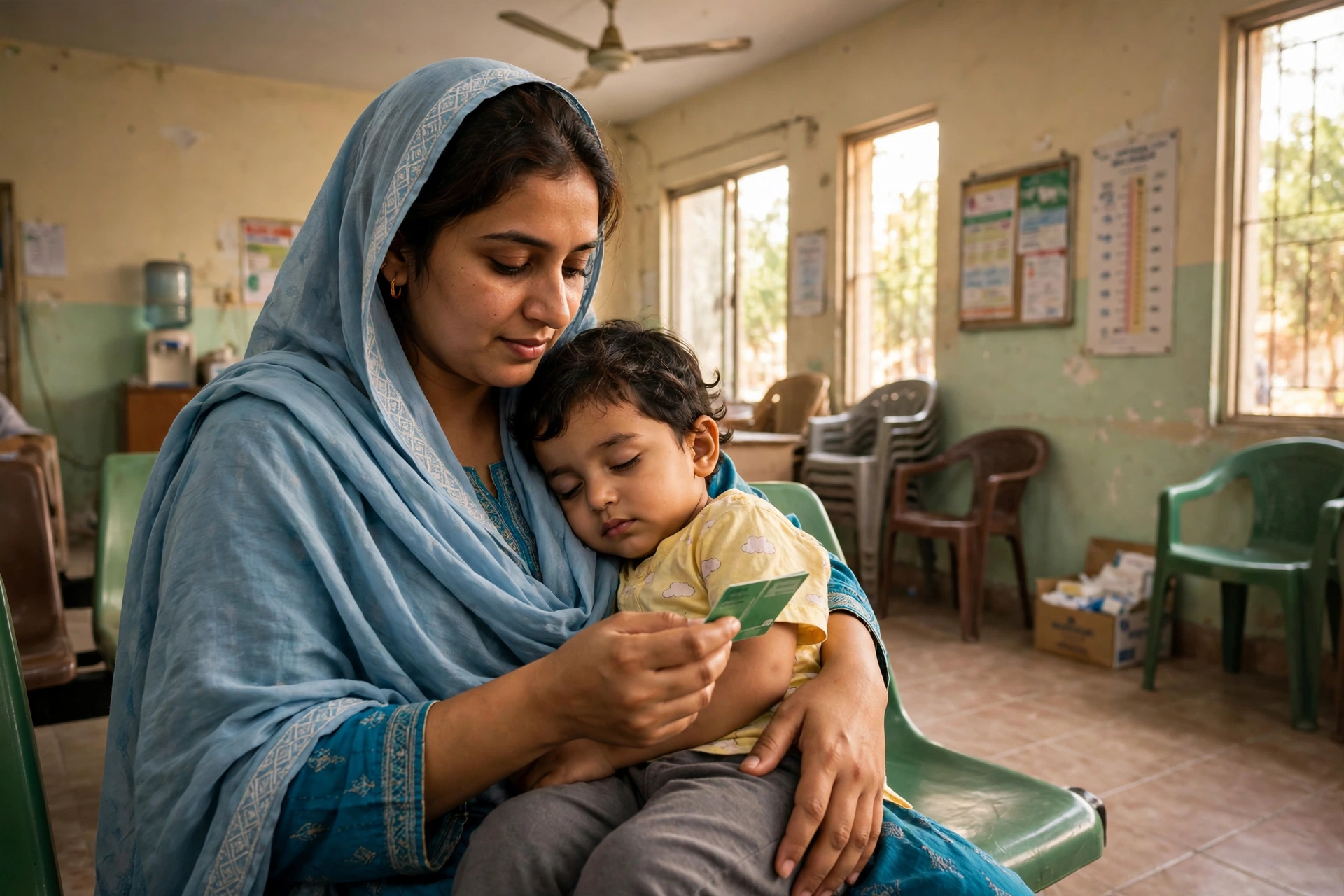
If you are a new parent in Pakistan, the one document that matters most in your baby’s first fifteen months is a small green booklet: the EPI card. It holds the immunization schedule in Pakistan — the national vaccination chart run by the Expanded Programme on Immunization (EPI) — and it tells you exactly which vaccine your child gets at which age. This guide lays out that full schedule, visit by visit, explains what each vaccine protects against, and answers the questions parents actually ask: is it free, where do you go, what should you bring, and what happens if you miss a dose. Everything here follows the national schedule published by the Federal Directorate of Immunization (FDI) and the World Health Organization’s immunization data for Pakistan.
One fact first, because it settles the biggest worry: all routine EPI vaccines are free at government vaccination centres across Pakistan. You do not pay for the vaccines, and you do not need to be registered anywhere special to get them — you take your child to the nearest EPI centre with the EPI card, and the vaccinator records each dose as it is given.
Key Takeaways
- The immunization schedule in Pakistan (EPI) covers 6 visits from birth to 15 months, with 19 doses protecting against 12 diseases.
- All EPI vaccines are free at government vaccination centres — bring your child’s EPI card to every visit.
- The six visits fall at birth, 6 weeks, 10 weeks, 14 weeks, 9 months, and 15 months.
- Pentavalent is one injection that protects against five diseases: diphtheria, whooping cough, tetanus, hepatitis B, and Hib meningitis.
- Measles is now given as the measles-rubella (MR) vaccine, in two doses at 9 and 15 months; the typhoid conjugate vaccine (TCV) is given at 9 months.
- A missed dose is not a reason to start over — take your child to the centre as soon as you can and the vaccinator will catch up the schedule.
- The schedule can change, so the EPI card and your vaccinator are the final word — always check against them.
Table of Contents
- What Is the EPI Immunization Schedule in Pakistan?
- The Full EPI Schedule: Vaccination Chart by Age
- What Each Vaccine Protects Against
- Polio Vaccine Schedule in Pakistan
- What Is the Hifazti Injection Schedule?
- Where to Get Your Child Vaccinated
- What to Bring to Each Visit
- What If You Miss a Dose?
- Vaccine Side Effects: What Is Normal?
- Vaccination During Pregnancy: Tetanus Shots
- Frequently Asked Questions
What Is the EPI Immunization Schedule in Pakistan?
What is the EPI immunization schedule in Pakistan?
The EPI immunization schedule in Pakistan is the national timetable of childhood vaccines published by the Federal Directorate of Immunization (FDI), which runs the Expanded Programme on Immunization. It sets out six clinic visits between birth and 15 months, during which a child receives 19 doses of vaccine, free of charge, protecting against 12 diseases: tuberculosis, polio, diphtheria, whooping cough, tetanus, hepatitis B, Hib meningitis, pneumonia, rotavirus diarrhoea, measles, rubella, and typhoid. The same schedule is printed on every child’s EPI card and displayed at every EPI centre, so the card you hold and the chart in this guide should match.
The programme has been running for decades, and the schedule itself has changed over time as new vaccines were added. Pneumococcal vaccine joined the schedule in 2013, the typhoid conjugate vaccine was added in 2019 after extensively drug-resistant typhoid appeared in Sindh, and the standalone measles vaccine has been replaced by the combined measles-rubella vaccine. A second injected polio dose (IPV-2) now sits at 9 months. That is why older advice from relatives — “we only had three visits” — does not match today’s chart, and why it is worth checking the current schedule rather than relying on memory.
The schedule below follows the WHO immunization data for Pakistan and the FDI’s published national schedule. The government can change the schedule, so treat this guide as the current chart and confirm it against your child’s EPI card or your vaccinator at each visit.
The Full EPI Schedule: Vaccination Chart by Age
Here is the complete national schedule, visit by visit. There are six visits, and the ages matter: the vaccines are timed to protect your child at the ages when each disease is most dangerous, so try to keep to the dates on the card.
| Visit | Age | Vaccines your child gets |
|---|---|---|
| 1 | At birth | BCG (TB), OPV-0 (first oral polio drops), hepatitis B birth dose |
| 2 | 6 weeks | OPV-1, rotavirus-1, PCV-1 (pneumococcal), pentavalent-1 |
| 3 | 10 weeks | OPV-2, rotavirus-2, PCV-2, pentavalent-2 |
| 4 | 14 weeks | OPV-3, IPV-1 (injected polio), pentavalent-3, PCV-3 |
| 5 | 9 months | Measles-rubella (MR-1), typhoid conjugate vaccine (TCV), IPV-2 (second injected polio dose) |
| 6 | 15 months | Measles-rubella (MR-2) |
That is 19 doses in total across the six visits. A few things worth noticing in the chart: the first three visits after birth come at 6, 10, and 14 weeks — four weeks apart — because the pentavalent, polio, pneumococcal, and rotavirus vaccines each need three doses to build full protection. There is no rotavirus dose at the 14-week visit. And the 9-month visit is a busy one, with three different vaccines, because that is when the measles-rubella and typhoid vaccines are first due.
What Each Vaccine Protects Against
The vaccine names on the card can look like alphabet soup, so here is what each one actually does, in plain words.
| Vaccine | Doses | Protects against |
|---|---|---|
| BCG | 1 (at birth) | Severe childhood tuberculosis — TB meningitis and TB spread through the body |
| OPV (oral polio) | 4 (birth, 6, 10, 14 weeks) | Poliomyelitis (polio) |
| IPV (injected polio) | 2 (14 weeks, 9 months) | Poliomyelitis (polio) |
| Hepatitis B (birth dose) | 1 (at birth) | Hepatitis B infection |
| Pentavalent (DPT-HepB-Hib) | 3 (6, 10, 14 weeks) | Diphtheria, tetanus, whooping cough (pertussis), hepatitis B, and Hib — a cause of meningitis |
| PCV (pneumococcal) | 3 (6, 10, 14 weeks) | Pneumococcal disease — pneumonia and meningitis caused by Streptococcus pneumoniae |
| Rotavirus | 2 (6, 10 weeks) | Severe diarrhoea caused by rotavirus |
| Measles-rubella (MR) | 2 (9, 15 months) | Measles and rubella (German measles) |
| Typhoid conjugate (TCV) | 1 (9 months) | Typhoid fever |
Pentavalent deserves a special mention because it does the most work in a single injection: one shot protects against five diseases. That is why it is given three times — each dose strengthens the protection. And the measles-rubella vaccine works the same way in two steps: published estimates put protection at about 85% after the first dose and about 97% after the second, which is why the 15-month dose matters and should not be skipped.
Polio Vaccine Schedule in Pakistan
What is the polio vaccine schedule in Pakistan?
Pakistan’s polio schedule gives a child six polio doses in the first year: four oral polio drops (OPV-0 at birth, then OPV-1, OPV-2, and OPV-3 at 6, 10, and 14 weeks) and two injected polio doses (IPV-1 at 14 weeks and IPV-2 at 9 months). Pakistan is one of the last countries where polio still circulates, which is why the schedule uses both kinds of polio vaccine — the drops and the injection — and why polio teams also visit homes during national campaigns. Campaign doses are extra protection on top of the routine schedule, not a replacement for it: your child still needs the routine doses on the EPI card.
If a polio team comes to your door, let them vaccinate your child and keep the routine EPI visits going as well. The two work together, and the vaccinator at the EPI centre will record the routine doses on the card either way.
What Is the Hifazti Injection Schedule?
What is the Hifazti injection schedule?
The “Hifazti injection” schedule is the same EPI schedule in this guide. “Hifazti teeka” is the name many families in Pakistan use for the routine childhood vaccines — it simply means the protective injection. So when someone asks about the Hifazti injection schedule, the Hifazti injection for a baby, or the Hifazti teeka chart, the answer is the six-visit EPI chart above: birth, 6 weeks, 10 weeks, 14 weeks, 9 months, and 15 months. There is no separate Hifazti schedule, and no separate vaccine by that name — it is the same BCG, polio, pentavalent, pneumococcal, rotavirus, measles-rubella, and typhoid vaccines, given free at the same EPI centres.
Where to Get Your Child Vaccinated
EPI vaccines are given at government vaccination centres — the EPI centres attached to basic health units, rural health centres, tehsil and district hospitals, and many government dispensaries. There are thousands of these centres across Punjab and the rest of Pakistan, and the vaccines there are free. Private hospitals and clinics also give childhood vaccines, but they charge for them, and their schedules sometimes include extra vaccines that are not part of the free EPI programme. If you use a private clinic, ask which vaccines on their chart are the EPI ones and which are additional, so you know what you are paying for.
To find your nearest centre, ask at your local basic health unit or hospital, or ask the Lady Health Worker or vaccinator in your area — they know the centre days and timings for your neighbourhood. Take the EPI card with you every time; it is the record the vaccinator works from.
What to Bring to Each Visit
Keep it simple. You need three things:
- The EPI card — the vaccinator records each dose on it, with the date. Without the card, the vaccinator has to work out what your child has already had, which wastes time and risks a repeated or missed dose. If you lose the card, tell the vaccinator at once; the centre keeps its own register and can issue a replacement.
- Your child’s birth record (for the first visit) — the birth certificate or hospital discharge slip, so the vaccinator can record the correct date of birth and start the card.
- Your child, fed and rested if possible — a hungry or overtired baby cries more and settles more slowly after the injection. Dress your baby in clothes that leave the thigh or upper arm easy to reach, depending on the vaccine.
After the injection, stay at the centre for about 15 to 30 minutes before leaving, so the staff can watch for any immediate reaction. This is standard practice everywhere, not a sign that something is wrong.
What If You Miss a Dose?
What happens if my child misses a vaccine dose?
Nothing is ruined — and you do not start the schedule over. If your child misses a visit, take them to the EPI centre as soon as you can, and the vaccinator will give the missed dose and work out the timing for the remaining ones. This is called catch-up vaccination, and it is a normal part of the programme. Children miss doses all the time — because of illness, travel, a centre being closed, or simply because life got in the way — and the schedule is designed to cope with it. The important thing is not to wait for the next scheduled visit if you can go sooner, because the longer the gap, the longer your child goes without that protection. And do not skip a dose because your child has a mild cold or a low fever; tell the vaccinator, who will decide — most mild illnesses are not a reason to delay.
Vaccine Side Effects: What Is Normal?
What are the normal side effects of childhood vaccines?
Most children have no side effects at all, and when side effects do happen they are usually mild and short-lived: soreness, redness, or a small swelling where the injection was given, a mild fever, or a baby who is fussier and sleepier than usual for a day or two. These are signs the immune system is responding, and they settle on their own. You can comfort your baby with holding and feeding, and keep the injection site clean and uncovered. If a fever or crying worries you, or if your child develops a rash, swelling that spreads, or difficulty breathing, seek medical care promptly — serious reactions are very rare, but they need to be checked quickly. The vaccinator will also tell you what to watch for after each visit, so ask if anything is unclear.
Vaccination During Pregnancy: Tetanus Shots
The EPI programme does not only cover children. Pregnant women receive tetanus toxoid (TT) doses under the same programme, because tetanus protection passes from the mother to the newborn and protects both of them. The timing depends on whether you have had tetanus shots before, so it is recorded on the mother’s own card, not the baby’s. If you are pregnant and have not had tetanus shots, or you are not sure, ask the vaccinator or the Lady Health Visitor at your first antenatal visit — they will work out the doses from your history.
Frequently Asked Questions
Is the immunization schedule in Pakistan free?
Yes. All routine EPI vaccines are free of charge at government vaccination centres across Pakistan. You do not pay for the vaccines themselves. Private clinics charge for the same vaccines and sometimes add extra ones, so check what is on their bill.
How many vaccines does a child get by 15 months?
Nineteen doses across six visits: 3 at birth, 4 at 6 weeks, 4 at 10 weeks, 4 at 14 weeks, 3 at 9 months, and 1 at 15 months. Together they protect against 12 diseases.
What is the EPI schedule for a newborn baby?
At birth, a newborn gets three things: the BCG vaccine against tuberculosis, the first oral polio drops (OPV-0), and the hepatitis B birth dose. These are usually given at the hospital before discharge, or at the nearest EPI centre within the first days of life.
What is the difference between OPV and IPV?
OPV is the oral polio vaccine — drops given by mouth. IPV is the inactivated polio vaccine — an injection. Pakistan’s schedule uses both: four OPV doses and two IPV doses. They work together, and one does not replace the other.
Can my child get vaccinated if they have a cold?
Usually yes. A mild cold, a runny nose, or a low fever is not normally a reason to delay vaccination. Tell the vaccinator about the illness and let them decide. A serious illness or a high fever may mean waiting a few days — the vaccinator will tell you.
What is the measles vaccine schedule in Pakistan?
Measles is given as the combined measles-rubella (MR) vaccine, in two doses: MR-1 at 9 months and MR-2 at 15 months. Both doses are needed for full protection — about 85% after one dose and about 97% after two, by published estimates.
What is the typhoid vaccine schedule in Pakistan?
The typhoid conjugate vaccine (TCV) is given once, at 9 months, as part of the routine EPI schedule. It was added to the national schedule in 2019.
Where is the nearest vaccination centre?
The nearest EPI centre is usually at your local basic health unit, rural health centre, or government hospital. Your Lady Health Worker or vaccinator can tell you the centre days and timings for your area. A separate guide on finding vaccination centres and their timings is planned next in this series.
What should I do if I lost my child’s EPI card?
Go to the EPI centre and tell the vaccinator. The centre keeps its own register of the doses it has given, so it can check what your child has had and issue a replacement card. Do not delay the next visit while you look for the card.
Are private hospital vaccines different from EPI vaccines?
The core vaccines are the same, but private clinics often add extra vaccines that are not part of the free EPI programme — for example, additional doses or vaccines against diseases EPI does not yet cover. Ask the clinic which vaccines are EPI ones and which are extra, and what each costs, before you agree.
Is this the latest immunization schedule in Pakistan?
This guide follows the national schedule published by the Federal Directorate of Immunization and the World Health Organization’s immunization data for Pakistan — the routine schedule of six visits from birth to 15 months, with the measles-rubella vaccine and the typhoid conjugate vaccine in their current places. The schedule does change over time as vaccines are added, so the final word is always your child’s EPI card and your vaccinator, who work from the current national chart.
What is the hepatitis B vaccine schedule in Pakistan?
Hepatitis B is given in two parts of the EPI schedule: a birth dose given at birth, and then hepatitis B again inside each of the three pentavalent doses at 6, 10, and 14 weeks. Pentavalent is one injection that protects against five diseases, and hepatitis B is one of them — so a child who completes the three pentavalent doses has had four hepatitis B doses in total, counting the birth dose.
Is the immunization schedule available in Urdu?
Yes. The EPI card itself is printed in Urdu as well as English, and the vaccination chart is displayed at EPI centres in Urdu too. If reading the card is difficult, your vaccinator or Lady Health Visitor can walk you through the dates in Urdu at any visit — that is part of their job, so do ask.
Do adults need any EPI vaccines?
Adults are not on the childhood EPI schedule, but pregnant women receive tetanus toxoid doses under the programme. Other adult vaccines — such as hepatitis B for healthcare workers — are given through separate programmes, not through the childhood EPI card.
Sources: Federal Directorate of Immunization (FDI), Expanded Programme on Immunization, Pakistan — National Vaccination Schedule (epi.gov.pk); World Health Organization, Immunization Data portal — vaccination schedule for Pakistan; UNICEF Pakistan immunization programme information. The schedule can change; confirm against your child’s EPI card or your vaccinator. This article is general information only and is not medical advice. For questions about your child’s health or vaccinations, speak to your vaccinator or doctor.
Related reading: Paramedical Courses in Pakistan: Complete Guide · Allied Health Sciences in Pakistan: Fields, Courses and Careers · All 18 RIAHS Programs · Medical Tools — and if community and public health work interests you, the Public Health Technician program at RIAHS covers epidemiology, disease prevention, and community health.