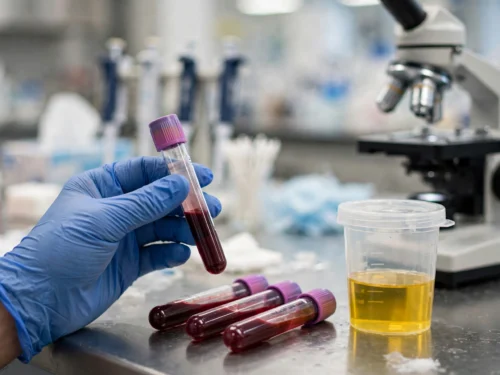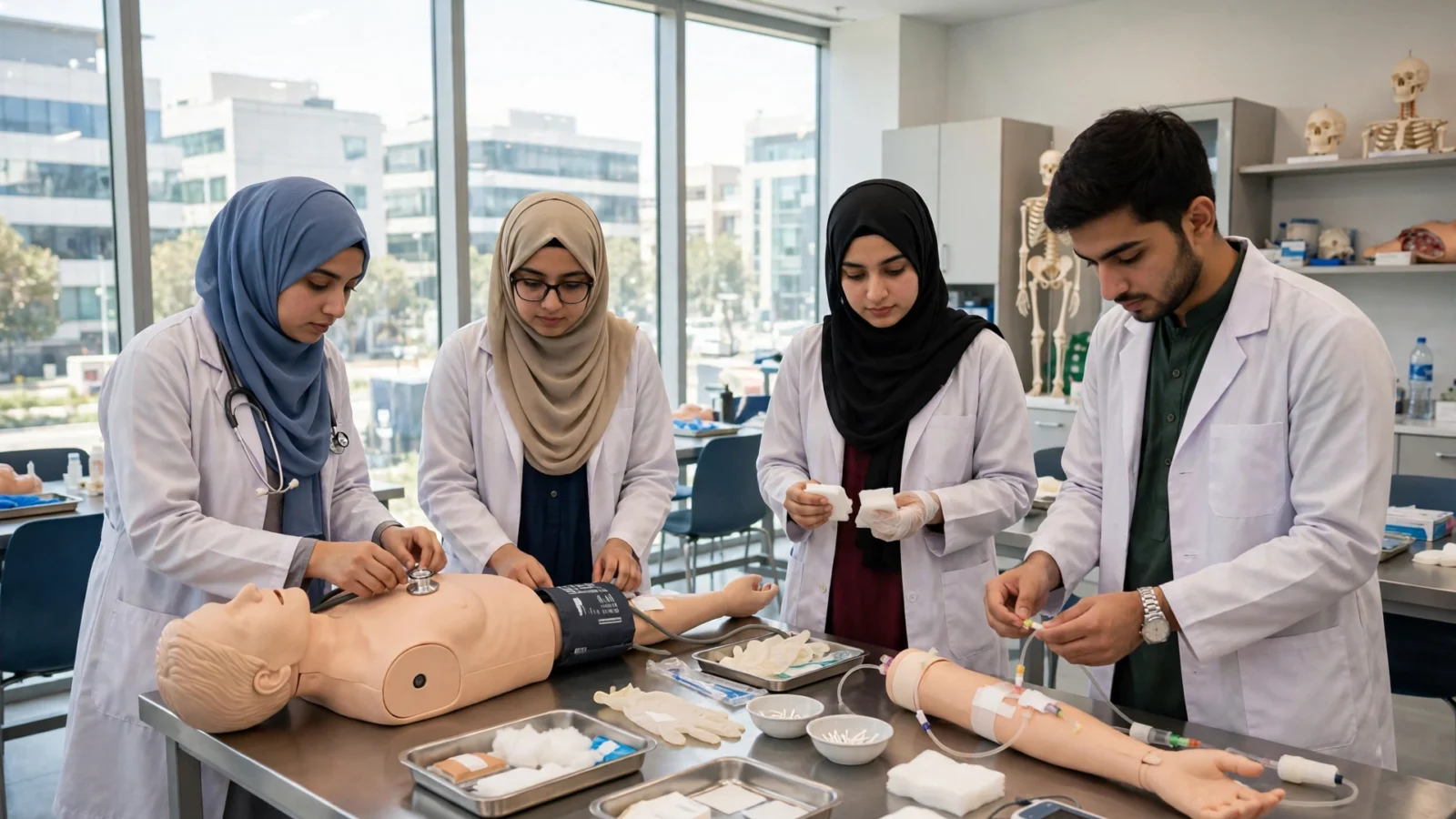
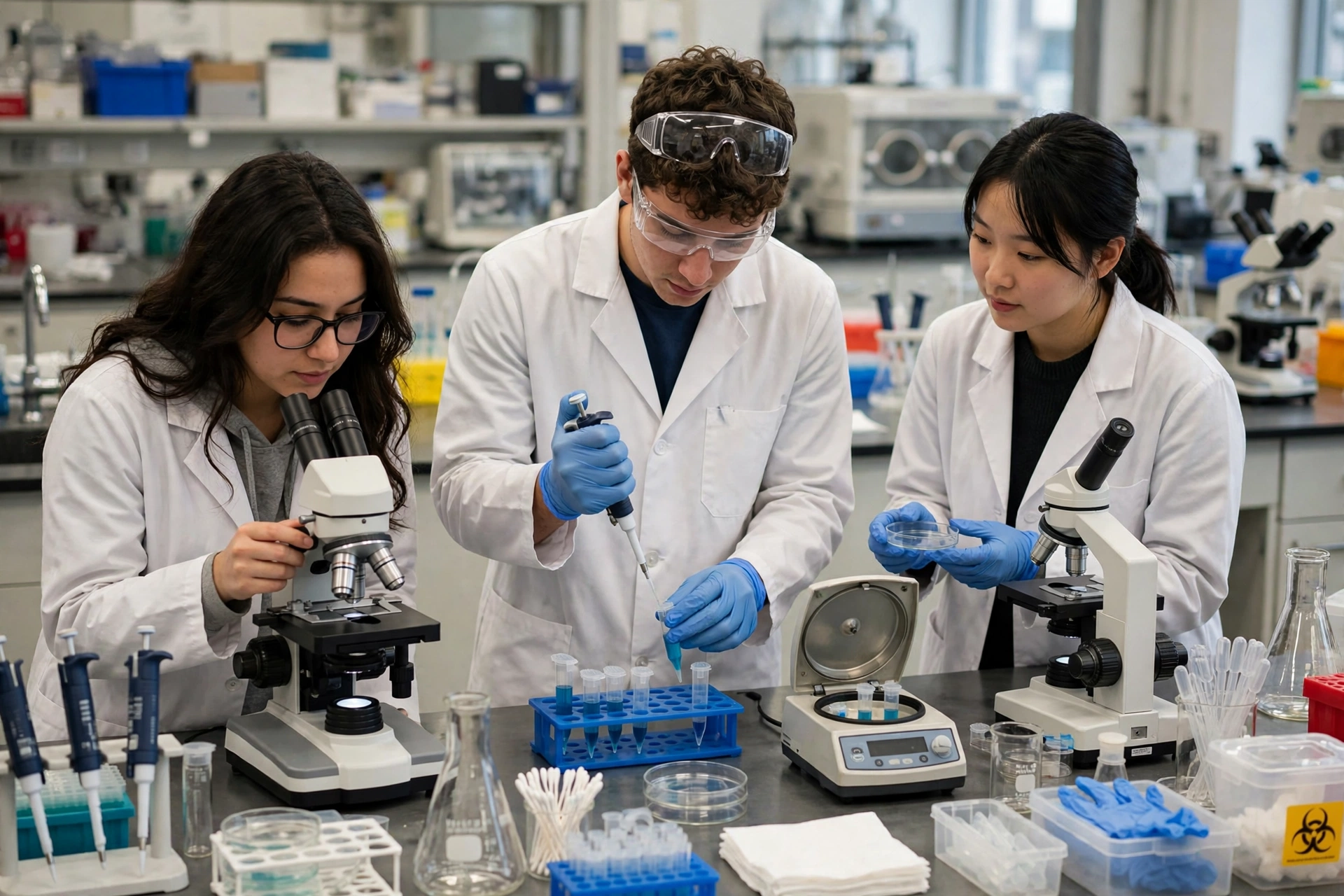
If you have just finished Matric and you want a healthcare career without spending six years in medical college, allied health sciences is probably the field you keep hearing about — and it is worth understanding properly before you pick a course. Allied health sciences covers the trained professionals who keep hospitals, labs, and clinics running: the lab technicians who run your blood tests, the radiographers who take your X-rays, the dispensers who prepare your medicines, and the theatre technicians who keep the operating room ready. This guide explains what allied health sciences means in Pakistan, which fields and courses fall under it, how long they take, who can apply, what the scope and jobs look like, and how the diploma route at RIAHS fits in — in plain language, without inflated claims.
One thing to know upfront: RIAHS — the Ravi Institute of Allied Health Sciences in Shahdara, Lahore — is a PMF-affiliated institute that offers 18 allied health diploma programs across three categories, starting after Matric. This article is the hub guide for that whole field: it links to the individual course guides we have already published, so you can go from the big picture here to the detail of any single program in one click.
Key Takeaways
- Allied health sciences is the umbrella term for the healthcare professions that support doctors and nurses — laboratory, imaging, pharmacy, theatre, therapy, and community health work.
- In Pakistan, the main entry route after Matric is a PMF-affiliated diploma: most RIAHS programs run 2 years, with CMW at 18 months and CNA at 1 year.
- Eligibility is simple: Matric with at least 45% marks. Category A and most Category B programs need Matric (Science); Category C programs accept Matric from any group. LHV and CMW are female-only.
- RIAHS offers 18 programs — 8 in Category A, 6 in Category B, and 4 in Category C — all affiliated with the Punjab Medical Faculty (PMF).
- Graduates work in hospitals, diagnostic laboratories, clinics, imaging centres, pharmacies, and community health programs across Punjab and beyond.
- There is no single “best” course: the right choice depends on whether you prefer lab work, patient care, imaging, or community health.
- Fees are confirmed on a campus visit or WhatsApp inquiry — this guide does not quote a figure, because fees vary by program and session.
Table of Contents
- What Is Allied Health Sciences?
- Allied Health Sciences Fields in Pakistan: The 18 Courses
- How Many Years Is the Allied Health Sciences Course?
- Allied Health Sciences Degree vs Diploma: Which Route Fits You?
- Who Can Apply? Eligibility Criteria
- How to Apply at RIAHS
- Scope of Allied Health Sciences in Pakistan
- Allied Health Sciences Jobs and Salary
- Which Allied Health Sciences Course Is Best?
- Allied Health Sciences vs Paramedical, vs MBBS, vs Nursing
- Is Allied Health Sciences a Good Major?
- Frequently Asked Questions
What Is Allied Health Sciences?
What is allied health sciences?
Allied health sciences is the group of healthcare professions that work alongside doctors and nurses to diagnose, treat, and prevent illness. When a doctor orders a blood test, an X-ray, or a medicine, an allied health professional is the person who actually runs the test, operates the machine, or prepares the medicine. The field covers laboratory science, medical imaging, pharmacy support, operation theatre support, physiotherapy, dental hygiene, anaesthesia support, dialysis, sterilisation, and community and maternal health. Without these professionals, a hospital simply cannot function — the doctor’s diagnosis depends on their work.
The term is broad on purpose. It is not one job, and it is not one course. It is a family of related professions, each with its own training, its own skills, and its own career path. Some allied health workers spend their day in a laboratory looking through microscopes. Others work in operating theatres, in X-ray departments, at the pharmacy counter, or out in communities visiting mothers and newborns. What they share is this: their work is practical, hands-on, and directly tied to patient care, and their training is shorter and more focused than a medical degree.
In Pakistan, the term is used in two slightly different ways, and the difference matters when you are choosing a course. Universities offer 4-year BS degrees in allied health fields — for example, a BS in Medical Laboratory Technology or a BS in Radiology. Separately, the Punjab Medical Faculty (PMF) runs a diploma system: 2-year diplomas (and a few shorter ones) that start right after Matric. Both routes lead into the same professions, but they start at different points and take different amounts of time. RIAHS belongs to the second route: it is a PMF-affiliated institute, and its programs are diplomas, not university degrees. This guide explains both routes honestly, so you can choose with your eyes open.
Allied Health Sciences Fields in Pakistan: The 18 Courses
RIAHS offers 18 PMF-affiliated programs, organised into three categories. Category A programs are equal to F.Sc (Medical Technology Group) under the New Scheme of Studies. Category B programs share a common first year — the Core Course — and specialise in the second year. Category C programs are the community and pharmacy programs with their own durations. Here is the full list, with what each field actually does day to day.
| Program | Category | Duration | What the work looks like |
|---|---|---|---|
| Dispenser | A | 2 years | Preparing and dispensing medicines, managing pharmacy stock, and counselling patients on how to take their medicine. |
| Medical Laboratory Technician (MLT) | A | 2 years | Running blood, urine, and tissue tests in haematology, microbiology, and clinical chemistry. |
| Radiography & Imaging Technician | A | 2 years | Operating X-ray, ultrasound, and CT scanning systems in hospitals and imaging centres. |
| Operation Theater Technician | A | 2 years | Preparing surgical instruments, sterilisation, and supporting surgeons inside the operating theatre. |
| Physiotherapy Technician | A | 2 years | Rehabilitation exercises, electrotherapy, and musculoskeletal treatment to help patients recover movement. |
| Ophthalmic Technician | A | 2 years | Vision testing, ophthalmic equipment, and supporting eye surgeons in clinics and eye hospitals. |
| Cardiac Technician | A | 2 years | Operating ECG machines and cardiac monitors, and assisting cardiologists in diagnostic and interventional procedures. |
| Dental Hygienist | A | 2 years | Preventive dental care, oral screenings, and teaching patients about oral hygiene. |
| Public Health Technician | B | 2 years | Epidemiology, disease prevention, and community health work with government departments and NGOs. |
| Renal Dialysis Technician | B | 2 years | Operating haemodialysis machines and caring for patients with chronic kidney disease in dialysis centres. |
| Anesthesia Technician | B | 2 years | Assisting with anaesthesia, monitoring patient vitals, and maintaining anaesthesia equipment in theatres. |
| Endoscopy Technician | B | 2 years | Assisting with gastrointestinal endoscopic procedures and scope sterilisation. |
| CSSD Technician | B | 2 years | Managing sterilisation of all medical and surgical instruments and running sterile supply operations. |
| Mortuary Assistant | B | 2 years | Assisting with post-mortem procedures, body preparation, documentation, and mortuary administration. |
| LHV — Lady Health Visitor | C | 2 years | Maternal and child health visits, family planning counselling, and preventive healthcare in communities. Female only. |
| CMW — Community Midwife | C | 18 months | Skilled birth attendance, antenatal care, and postnatal support in community settings. Female only. |
| CNA — Certified Nursing Assistant | C | 1 year | Basic patient care, monitoring vitals, and supporting nursing staff in hospitals and clinics. |
| B-Category (Pharmacy Technician) | C | 2 years | Assisting pharmacists with dispensing, inventory, compounding, and pharmacy operations. |
If you want the detail on any one program — subjects, eligibility, and career scope — the linked course guides above cover each one in full. The Paramedical Courses in Pakistan guide covers the same 18 programs from the admissions angle, if you want a second view of the same list.
How Many Years Is the Allied Health Sciences Course?
How many years is the allied health sciences course?
Most allied health diploma courses in Pakistan take 2 years. That is the standard length for all eight Category A programs and all six Category B programs at RIAHS, and it is the same for the LHV and Pharmacy Technician programs in Category C. Two programs are shorter: CMW (Community Midwife) takes 18 months, and CNA (Certified Nursing Assistant) takes 1 year. So if you start after Matric, you can be qualified and working in one to two years — far sooner than a medical degree, and sooner than a 4-year university BS as well.
The university route is longer. A BS in an allied health field is normally a 4-year degree, and it starts after F.Sc (Pre-Medical) or an equivalent qualification, not after Matric. After that, postgraduate options such as an MSc or MPhil add another 2 years. The diploma route and the degree route are not rivals; they are different rungs on the same ladder. A diploma gets you into work quickly, and a diploma holder can later build on it with further study if they want to. What matters is matching the route to where you are now: if you have just finished Matric, the diploma is the route that is open to you today.
Allied Health Sciences Degree vs Diploma: Which Route Fits You?
This is the question that confuses the most families, so here is the honest comparison. A diploma (the PMF route) starts after Matric, takes 1–2 years, and is practical and job-focused: you learn the skills of one specific profession and you qualify to work in it. A degree (the university BS route) starts after F.Sc, takes 4 years, and is broader: you study the science in more depth, alongside general university subjects, and you graduate with a bachelor’s degree. Neither is “better” in the abstract. A diploma is better if you want to start earning sooner and you are sure about the field. A degree is better if you want the option of postgraduate study and university-level roles later, and you can afford four more years of study.
Two related qualifications come up often in searches, so let us place them correctly. An MSc or MPhil in allied health sciences is a postgraduate degree — you can only apply after a bachelor’s degree, so it is not a starting point after Matric. And MCPS is a postgraduate medical diploma awarded by the College of Physicians and Surgeons Pakistan (CPSP) to doctors — it is not an allied health qualification and RIAHS does not offer it. If someone offers you an “MCPS in allied health” or a “BSc after Matric”, be careful: check what is actually being offered, and by whom.
RIAHS offers diplomas, and it says so plainly. The institute does not award university degrees, and it does not claim to. What it does offer is PMF-affiliated diploma training that starts after Matric and leads directly into hospital, laboratory, and community health work. If your longer-term goal is a degree — say, a BS or even an MPH in public health much later — a diploma is a genuine first step, not a dead end. Many diploma holders work for a few years, then study further with a clear idea of what they want.
Who Can Apply? Eligibility Criteria
Who is eligible for allied health sciences courses in Pakistan?
The entry bar for a PMF diploma is deliberately low, because these programs are designed for students coming straight out of Matric. The headline requirement is the same across all three categories: Matric with at least 45% marks. Beyond that, the categories differ in the subject group they need. Category A programs — Dispenser, MLT, Radiography, Operation Theater Technician, Physiotherapy Technician, Ophthalmic Technician, Cardiac Technician, and Dental Hygienist — need Matric (Science), with Biology, Chemistry, and Physics, and an age of 15–25 years at the time of admission. Most Category B programs also need Matric (Science); Public Health Technician and Mortuary Assistant accept any group. Category C programs — LHV, CMW, CNA, and Pharmacy Technician — accept Matric from any group, and LHV and CMW are female candidates only.
Admission is on a merit basis: higher Matric marks are prioritised, and seats are limited, so applying early matters. The documents you need are straightforward: your CNIC or B-Form (original and copy), your Matric certificate (original and 2 copies), and 4 recent passport-size photographs. Exact admission dates are announced each cycle — check the Notice Board on raviiahs.com for the current dates rather than trusting a date you saw on another website. Full eligibility details are on the Admissions page.
How to Apply at RIAHS
Applying is a short, transparent process. First, browse the Programs page and pick the program that matches your qualifications and interests — and if you are unsure, the admissions team will help you choose. Second, check your eligibility against the requirements above. Third, submit the application form on the Admissions page or visit the campus in person with your original documents and CNIC/B-Form for verification. Fourth, once your application is reviewed and merit is finalised, you will receive a call to confirm your seat and complete enrolment. The campus is open Monday to Saturday, 9:00 AM to 7:00 PM, at Opposite Sohrab Factory, Begum Kot, Sheikhupura Road, Shahdara, Lahore — phone 0346 4542144. A full step-by-step walkthrough is in our How to Apply guide.
On fees, here is the honest position: the fee structure is available on a campus visit or WhatsApp inquiry, and an installment plan is available — ask the accounts team at the time of enrolment. This guide does not quote a fee figure, because fees vary by program and by session, and a number copied from an old page would mislead you. A PMF registration fee is also paid at the time of admission.
Scope of Allied Health Sciences in Pakistan
What is the scope of allied health sciences in Pakistan?
The scope is real, and it is easy to see why. Every hospital, diagnostic laboratory, and clinic in Pakistan needs allied health staff, and the health system keeps growing: new hospitals open, new diagnostic centres open, and existing ones expand. A laboratory cannot run without MLTs. An X-ray department cannot run without radiographers. An operating theatre cannot run without theatre technicians and anaesthesia technicians. A pharmacy cannot run without dispensers and pharmacy technicians. That demand is structural — it does not depend on one employer’s hiring cycle — which is why allied health diplomas have held up as a practical career choice for Matric students for years.
Where do graduates actually work? The main employers are government and private hospitals, diagnostic laboratories, imaging and radiology centres, pharmacies (hospital and retail), dental clinics, eye hospitals, dialysis centres, and community health programs run by government departments and NGOs. Some graduates work in the public sector through government health departments; others work in private hospitals and labs, where hiring is continuous and often faster. A smaller number go on to work in the Gulf and other countries, where allied health technicians are also in demand — though that route depends on the destination country’s own licensing rules, so check those before planning around it.
Two things are worth saying plainly about scope. First, a diploma is a starting qualification, not a ceiling: with experience, diploma holders move into senior technician, supervisor, and training roles, and some go on to further study. Second, scope is not the same as a guaranteed job. No honest guide can promise you a post. What a diploma does is put you into a field where the jobs exist, the skills are transferable between employers, and the work is essential rather than optional. That is a solid foundation — but you still have to apply, interview, and build experience like everyone else.
Allied Health Sciences Jobs and Salary
What jobs can you get after allied health sciences, and what is the salary?
The jobs follow directly from the field you train in. An MLT graduate works as a laboratory technician. A radiography graduate works as a radiographer or imaging technician. A dispenser works in a hospital or retail pharmacy. An LHV or CMW works in maternal and community health. A cardiac technician works in a cardiology department. A dental hygienist works in a dental clinic. A CSSD technician works in hospital sterilisation. The job title usually matches the diploma, which makes the career path unusually clear: you know what you are training for from day one.
On salary, this guide will not give you a single number, because there is not one. Pay varies by sector (government vs private), by city, by employer, by shift, and — most of all — by experience. A fresh graduate’s starting pay is modest; a technician with five years of experience in a busy private hospital earns noticeably more; a supervisor or a technician working abroad earns more again. Anyone who quotes you one fixed “allied health salary” is either guessing or quoting one employer’s advert as if it were the whole market. If you want real numbers, ask the hospitals and labs in your own city what they pay for the role you are training for, and treat that as your benchmark. The useful fact is the direction, not a figure: allied health work pays a working wage from the start, and it rises with experience and further qualification.
Which Allied Health Sciences Course Is Best?
Which allied health sciences course is best?
There is no single best course — there is a best course for you, and it depends on what kind of work you actually enjoy. The honest way to choose is to match the course to your temperament, not to a ranking you saw online. Here is a practical way to think about it:
- If you like lab work and detail: MLT (Medical Laboratory Technician) or Dispenser. You will spend your day with samples, tests, and medicines, and precision matters more than people skills.
- If you like machines and technology: Radiography & Imaging Technician or Cardiac Technician. You will operate scanners, X-ray systems, and cardiac monitors.
- If you like hands-on patient care: CNA, LHV, or CMW. You will spend your day with patients, families, and communities — and for LHV and CMW, with mothers and newborns.
- If you like the operating theatre: Operation Theater Technician or Anesthesia Technician. Fast-paced, high-responsibility work inside the theatre team.
- If you like community and prevention work: Public Health Technician. Epidemiology, disease prevention, and health programs rather than hospital wards.
- If you want the shortest route into work: CNA at 1 year, or CMW at 18 months. Both get you qualified and earning sooner than a 2-year program.
One more consideration: think about where you want to work. Hospital-based fields (MLT, radiography, theatre, anaesthesia) have the most openings in cities. Community fields (LHV, CMW, public health) have strong demand across Punjab, including smaller towns and rural areas. If you are not sure, visit the RIAHS campus, talk to the admissions team, and ask to see the practical labs — an hour in the lab tells you more about whether you will enjoy the work than a week of reading course descriptions.
Allied Health Sciences vs Paramedical, vs MBBS, vs Nursing
These four terms get mixed up constantly, so here is the straight comparison.
| Path | Starts after | Duration | What you become |
|---|---|---|---|
| Allied health sciences (PMF diploma) | Matric | 1–2 years | Technician in a specific field — lab, imaging, pharmacy, theatre, community health |
| Paramedical courses | Matric | 1–2 years | The same thing — “paramedical” is the common name in Pakistan for these PMF diploma programs |
| MBBS | F.Sc (Pre-Medical) | 5 years + house job | Doctor — diagnoses and treats patients, prescribes treatment |
| Nursing (BSN / diploma) | F.Sc or Matric (by program) | 2–4 years | Nurse — direct patient care, ward management, bedside nursing |
The first thing to notice: allied health sciences and paramedical courses are the same thing in Pakistan. “Paramedical” is simply the name people use most often for the PMF diploma programs, and “allied health sciences” is the broader, more formal name for the same family of professions. If you see both terms, you are not looking at two different options — you are looking at one field with two names.
MBBS and nursing are different professions, not rivals to allied health. A doctor diagnoses and prescribes. A nurse delivers bedside care and manages wards. An allied health technician runs the tests, the machines, and the procedures that the doctor’s decisions depend on. In a hospital, the three work as a team, and none of them can do the other’s job. If your goal is to become a doctor, you need F.Sc (Pre-Medical) and an MBBS — a diploma will not get you there. If your goal is to start a healthcare career quickly after Matric, allied health is the route that is actually open to you.
Two more questions that come up in searches: is pharmacy allied health sciences? Yes — pharmacy technicians and dispensers are allied health professionals, and Pharm-D (the 5-year pharmacy doctorate) is a related but separate, degree-level route. And is physiotherapy allied health sciences? Yes — physiotherapy technicians are allied health professionals, and a DPT (Doctor of Physical Therapy) is the degree-level route in the same field.
Is Allied Health Sciences a Good Major?
Is allied health sciences a good major?
It is a good choice if you want a practical healthcare career that starts soon after Matric, teaches you a specific skill, and leads to work that hospitals genuinely need. It is not a good choice if what you really want is to become a doctor, or if you are only choosing it because someone told you it is “easy” — the training is hands-on and demanding, and the work carries real responsibility for patients. The students who do best in allied health are the ones who like practical work, are comfortable with detail, and actually want to be around patients and clinical settings.
Is it a STEM field? In the broad sense, yes — allied health sciences is built on biology, chemistry, and physics, and the training is scientific and technical. But it is not a STEM degree in the university sense: a PMF diploma is a professional, vocational qualification, not a BSc. If you need a degree that says “STEM” on it for a particular purpose, the university BS route is the one to take. If you need a qualification that gets you into a hospital job, the diploma does that directly.
Frequently Asked Questions
What does allied health sciences mean?
It means the group of healthcare professions that support doctors and nurses — laboratory, imaging, pharmacy, theatre, therapy, and community health work. Allied health professionals run the tests, operate the machines, prepare the medicines, and deliver the community care that modern healthcare depends on.
Is allied health sciences the same as paramedical?
Yes, in Pakistan the two terms describe the same field. “Paramedical courses” is the common name for the PMF diploma programs, and “allied health sciences” is the broader formal name for the same family of professions. The 18 programs at RIAHS are both.
Can I do allied health sciences after Matric?
Yes. The PMF diploma route starts after Matric — you need Matric with at least 45% marks. Category A and most Category B programs need Matric (Science); Category C programs accept Matric from any group.
Is there an entry test for allied health sciences at RIAHS?
Admission is on a merit basis, based on your Matric marks, with higher marks prioritised. There is no separate entry test mentioned for the diploma programs — but exact arrangements are announced each admission cycle, so check the Notice Board on raviiahs.com for the current cycle’s details.
What is the fee structure for allied health sciences in Pakistan?
Fees vary by program and by session. At RIAHS, the fee structure is available on a campus visit or WhatsApp inquiry, and an installment plan is available — ask the accounts team at the time of enrolment. A PMF registration fee is also paid at the time of admission. This guide does not quote a figure, because a copied number would quickly go out of date.
When does admission open for 2026?
Admission dates are announced each cycle and published on the RIAHS Notice Board. Do not rely on a date you saw on another website — check the Notice Board on raviiahs.com, or call the admissions team on 0346 4542144, for the current dates.
What subjects will I study in allied health sciences?
It depends on the program. Every program has its own subject list — for example, MLT covers haematology, microbiology, and clinical chemistry; Radiography covers imaging physics and anatomy; Dispenser covers pharmacology and dispensing practice. Category B programs share a Common Core Course in the first year and specialise in the second. The individual course guides linked in the table above list the subjects for each program.
Can I do a BSc after a PMF diploma?
A diploma is a professional qualification in its own right, and many diploma holders go straight into work. Further study is possible afterwards, but the exact route — whether a university will accept your diploma toward a degree — depends on that university’s own rules, so check with the university you are interested in rather than assuming.
Is a diploma enough to get a job in a hospital?
Yes — that is what the diplomas are designed for. Hospitals, diagnostic labs, imaging centres, pharmacies, and community health programs hire diploma holders for technician roles. Experience and further training then open up senior and supervisory roles.
Are LHV and CMW only for women?
Yes. At RIAHS, LHV (Lady Health Visitor) and CMW (Community Midwife) are female candidates only, as stated on the Admissions page. The other programs are open to both male and female candidates.
Where is RIAHS located, and how do I contact the admissions team?
RIAHS is at Opposite Sohrab Factory, Begum Kot, Sheikhupura Road, Shahdara, Lahore. The admissions team is available Monday to Saturday, 9:00 AM to 7:00 PM, on 0346 4542144 (WhatsApp available) or 042-37921012–15, or by email at Admin@raviiahs.com.
Sources and Further Reading
Facts in this guide were verified from the RIAHS Programs page and Admissions page on 2026-11-13, and from the Punjab Medical Faculty’s official site, pmfpunjab.edu.pk. Program names, categories, durations, eligibility rules, and contact details are taken from those pages. Course-level detail is covered in the individual guides linked in the table above.
Related Reading
- Paramedical Courses in Pakistan: Complete Guide to Eligibility, Fees and Careers
- MPH in Pakistan: Masters in Public Health Degree, Eligibility, Scope and Careers
- How to Apply at RIAHS: Step-by-Step Admission Guide
- LHV Course in Pakistan: Duration, Eligibility, Subjects and Career Scope
- Medical Laboratory Technician (MLT) Course in Pakistan