Every operation depends on a team you never see. Before a surgeon picks up a scalpel, someone has cleaned it, checked it, sterilised it, packed it, and made sure it stays sterile until the moment it is needed. That someone is a CSSD technician — and in Pakistan, the CSSD technician course is the two-year Punjab Medical Faculty diploma that trains you for exactly that job. CSSD stands for Central Sterile Supply Department, the department at the heart of every hospital’s infection control. This guide covers the course in full: how long it takes, who can apply, what you study, what it costs, and where you can work once you qualify.
If you have just finished Matric with Science and you want a hospital career that does not involve direct patient care, this is one of the most practical options on the Punjab Medical Faculty list. The work is steady, every hospital needs it, and the skills transfer to operating theatres, dental hospitals, and medical device companies. Read on for the honest detail — including the things the course does not promise.
Key Takeaways
- The CSSD technician course is a 2-year PMF-affiliated diploma at RIAHS in Shahdara, Lahore, in Category B — Core Course Programs.
- Eligibility: Matric (Science) with at least 45% marks. The first year is a Common Core Course shared with other Category B programs; CSSD specialisation begins in the second year.
- Subjects include microbiology and infection control, decontamination, steam sterilisation (autoclave) operation, sterile packaging and storage, and quality assurance.
- Training is hands-on at North Ravi Hospital on the RIAHS campus in Shahdara, Lahore.
- Fees are shared on a campus visit or WhatsApp inquiry — no fee figure is published online — and an installment plan is available.
- Graduates work in hospital central supply departments, operating theatre support units, dental hospitals, and medical device processing facilities.
- Admission is merit-based and seats are limited, so early application matters.
Table of Contents
- What Is a CSSD Technician?
- How Long Is the CSSD Technician Course?
- Who Can Apply? Eligibility Criteria
- What Will You Study? Subjects and Skills
- How to Apply at RIAHS
- CSSD Technician Course Fees in Pakistan
- Career Scope: Where Do CSSD Technicians Work?
- CSSD vs Other Category B Courses
- Is the CSSD Course Right for You?
- Why Study CSSD at RIAHS?
- Frequently Asked Questions
What Is a CSSD Technician?
What does CSSD stand for?
CSSD stands for Central Sterile Supply Department — sometimes also called Central Sterile Services Department. It is the hospital department responsible for cleaning, disinfecting, sterilising, packing, storing, and distributing every reusable medical and surgical instrument. Scissors, forceps, retractors, trays, drapes, and endoscope accessories all pass through the CSSD before they reach an operating theatre and again after they come back.
A CSSD technician is the person who runs that cycle. The job is less visible than nursing or surgery, but it is one of the most important infection-control roles in a hospital. A single mistake — an instrument that is not properly sterilised — can cause a surgical site infection that puts a patient’s life at risk. That is why hospitals treat the CSSD as a core department rather than a back room, and why trained technicians are in steady demand.
What does a CSSD technician do day to day?
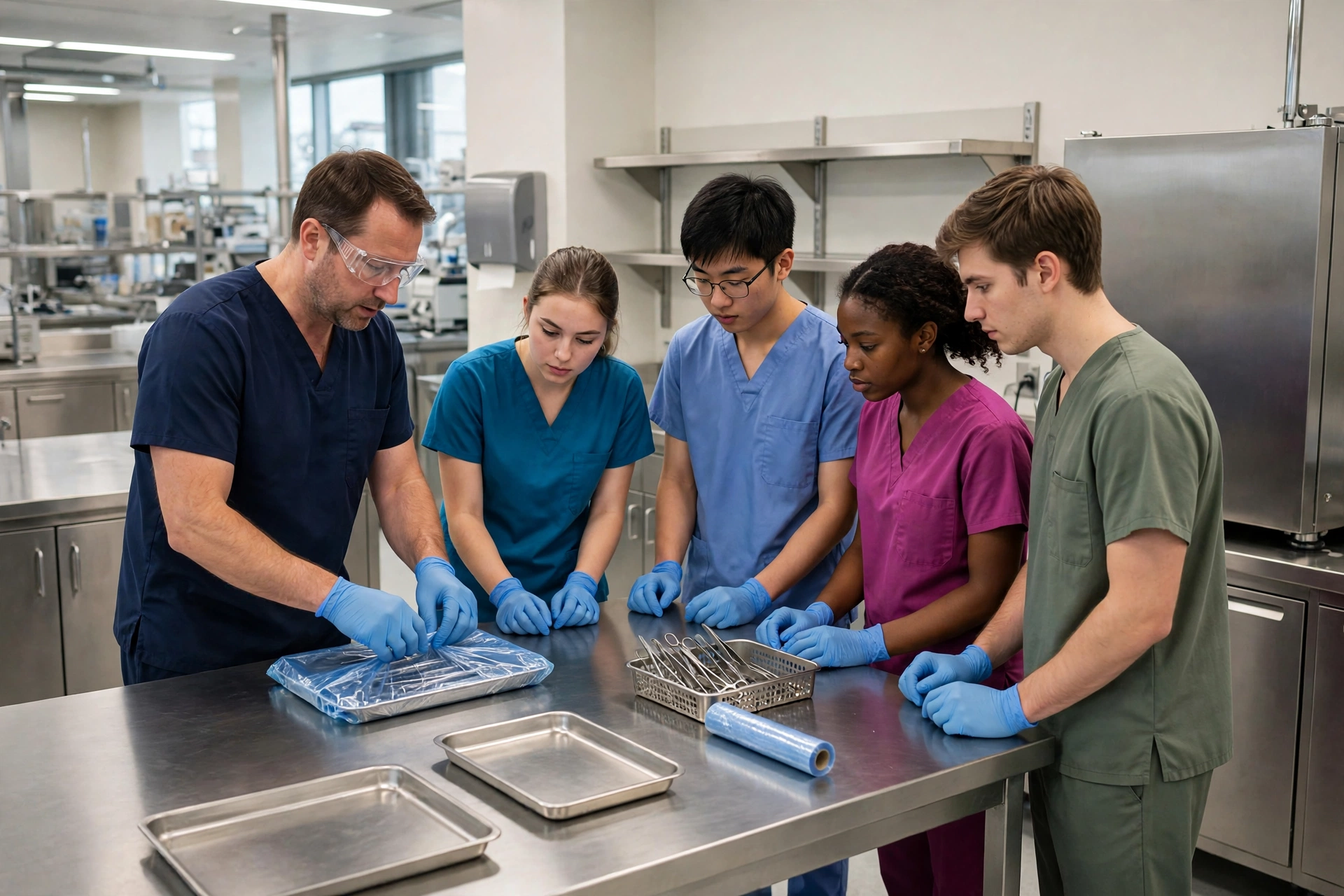
The daily work follows a strict one-way flow, and you will learn every step of it during the course. Used instruments arrive from the operating theatre or wards and are first decontaminated and cleaned — manually and in ultrasonic washers — to remove all visible soil. They are then inspected, function-tested, and assembled into sets. Each set is packed and labelled, then sterilised, most often in a steam steriliser (autoclave) and sometimes by chemical or dry-heat methods. After sterilisation the packs are stored in a sterile store and issued to theatres and wards on request. Every step is documented, because traceability — knowing which pack went to which patient — is part of the job.
Alongside the instruments, a CSSD technician monitors the sterilisation equipment itself: running biological and chemical indicator tests, keeping validation records, and flagging any failed cycle before the instruments are used. In short, the role mixes practical bench work, careful record-keeping, and a working knowledge of microbiology and infection control.
How Long Is the CSSD Technician Course?
How many years is the CSSD technician course?
The CSSD technician course at RIAHS is a 2-year diploma, affiliated with the Punjab Medical Faculty (PMF). It sits in Category B — Core Course Programs, which means the structure is different from the Category A courses. Your first year is a Common Core Course, shared with the other Category B programs, covering the foundational sciences and clinical basics every technician needs. CSSD specialisation begins in the second year, when the teaching turns to sterilisation science, decontamination, packaging, and department workflow in detail.
That shared first year is worth understanding before you apply. It means your first year of study is largely the same as a student training to be an anaesthesia technician or an endoscopy technician, and your specialist identity forms in year two. It also means the course builds on a broad base rather than narrowing from day one — useful if you are still deciding exactly which hospital department suits you.
Who Can Apply? Eligibility Criteria
What is the eligibility for the CSSD technician course?
To apply for the CSSD technician course at RIAHS you need Matric (Science) with a minimum of 45% marks in your board examination. There is no gender restriction listed for this program — unlike LHV and CMW, which are female only. The documents you need are your CNIC or B-Form (original and copy), your Matric certificate (original and two copies), and four recent passport-size photographs.
Two points students often ask about. First, the 15–25 year age limit applies to Category A programs only; no age limit is published for Category B programs like CSSD, so do not assume it applies here — confirm your own position with the admissions team if age is a concern. Second, admission is merit-based: higher Matric marks are prioritised, and seats are limited, so applying early genuinely helps.
| Requirement | CSSD Technician at RIAHS |
|---|---|
| Qualification | Matric (Science) |
| Minimum marks | 45% in board examination |
| Duration | 2 years |
| Category | Category B — Core Course Programs (PMF) |
| First year | Common Core Course (shared with other Category B programs) |
| Specialisation | Second year — CSSD |
| Age limit | None published for Category B (15–25 applies to Category A only) |
| Gender restriction | None listed |
| Documents | CNIC/B-Form, Matric certificate, 4 passport-size photos |
| Admission basis | Merit-based; seats limited |
What Will You Study? Subjects and Skills
What subjects are in the CSSD technician course?
The course teaches you the full sterilisation cycle, from dirty instrument to sterile pack, plus the science behind it. The subjects listed on the RIAHS program page are:
- Microbiology and infection control principles — how microbes spread in hospitals and how sterilisation breaks the chain.
- Decontamination and cleaning methods — manual cleaning, ultrasonic washers, and washer-disinfectors.
- Steam sterilisation (autoclave) operation — the workhorse of the CSSD: loading, cycles, and monitoring.
- Chemical and dry-heat sterilisation — the methods used when steam is not suitable.
- Sterile packaging and storage — wrapping, sealing, labelling, and keeping packs sterile until use.
- Tracking and distribution systems — issuing sets to theatres and wards, and tracing packs to patients.
- Quality assurance and validation — biological and chemical indicators, failed-cycle procedures, and records.
- CSSD layout and workflow management — the one-way flow from dirty to clean to sterile, and how a department is run.
Alongside the classroom teaching, the course includes hands-on training at North Ravi Hospital on the RIAHS campus in Shahdara, Lahore. That matters more than it sounds: sterilisation is a practical skill, and employers want technicians who have actually loaded an autoclave and packed a tray, not just read about it.
How to Apply at RIAHS
How do I apply for the CSSD technician course?
Applying is straightforward, and the same process covers all RIAHS programs. First, check that you meet the eligibility above — Matric (Science) with at least 45%. Then submit your application: fill in the form on the admissions page, or visit the campus in person. Bring your original documents and CNIC or B-Form for verification. Once your application is reviewed and the merit list is finalised, you will receive a call to confirm your seat and complete enrollment.
Exact admission dates are announced each cycle, so check the Notice Board for the current dates rather than relying on last year’s schedule. Students from Karachi and other cities apply the same way, and attend the course in person at the Lahore campus. If you are unsure whether CSSD is the right Category B choice for you, the admissions team can talk you through it — they are available Monday to Saturday, 9:00 AM to 7:00 PM, on 0346 4542144, or on WhatsApp. The campus is opposite Sohrab Factory, Begum Kot, Sheikhupura Road, Shahdara, Lahore.
CSSD Technician Course Fees in Pakistan
What is the fee for the CSSD technician course?
RIAHS does not publish a fee figure for the CSSD technician course online. The fee structure is shared on a campus visit or WhatsApp inquiry, and an installment plan is available — ask the accounts team at the time of enrollment. A PMF registration fee is also paid at the time of admission. This guide will not invent a fee figure, because fees change between admission cycles and a wrong number is worse than no number. If you see a fee quoted for this course on another website, treat it with caution unless it comes from RIAHS itself.
One practical tip: when you ask about fees, ask for the full picture in the same conversation — tuition per year, the PMF registration fee, any examination or practical charges, and the installment schedule. That way you can compare the real cost against other programs rather than a single headline figure.
Career Scope: Where Do CSSD Technicians Work?
What is the scope of the CSSD technician course in Pakistan?
Every hospital that does surgery needs a CSSD, and every CSSD needs trained technicians. That is the core of the career case: the demand is tied to hospital capacity, not to fashion, and it does not depend on a single employer or city. According to the RIAHS program page, CSSD technician graduates work in hospital central supply departments, operating theatre support units, dental hospitals, and medical device processing facilities. Larger hospitals run dedicated CSSD departments with shift teams; smaller hospitals and surgical centres may combine the role with theatre support duties.
Be honest with yourself about the work, though. It is shift-based, physical, and repetitive by design — the same careful cycle, done properly, every time. It is also work where precision matters more than speed, and where the reward is invisible when it goes right: no infections, no cancelled operations, no failed sterilisation cycles. If you are the kind of person who likes systems, checklists, and quiet responsibility, it suits you well. If you want constant patient contact, look instead at the CNA course or the LHV course.
| Workplace | What you do there |
|---|---|
| Hospital central supply department | Run the full sterilisation cycle for all reusable instruments |
| Operating theatre support unit | Prepare and issue sterile sets for surgery, manage theatre stock |
| Dental hospital | Sterilise dental instruments and manage small-scale CSSD workflow |
| Medical device processing facility | Process and package devices under controlled sterilisation standards |
What is the salary of a CSSD technician in Pakistan?
There is no reliable published salary figure for CSSD technicians in Pakistan, and this guide will not invent one. Pay depends on the hospital — government, private, or military — the city, the shift pattern, and your experience. What can be said honestly is that it is a salaried hospital role with regular hours and shift allowances in larger hospitals, and that experienced technicians who move into CSSD supervision or quality assurance roles earn more than entry-level staff. If salary is your main deciding factor, ask the RIAHS team about where recent graduates are working and what starting roles look like, rather than trusting a number on a random website.
CSSD vs Other Category B Courses
How is CSSD different from the other Category B programs?
All six Category B programs share the same first-year Common Core Course and the same 2-year duration, so the real difference is the second year — and the job afterwards. Here is how CSSD compares with its Category B siblings at RIAHS:
| Program | Second-year focus | Main workplace | Patient contact |
|---|---|---|---|
| CSSD Technician | Sterilisation, packaging, infection control | Central supply department | Minimal — instruments, not patients |
| Anesthesia Technician | Anaesthesia support, vitals monitoring | Operating theatre | High — beside the patient in theatre |
| Endoscopy Technician | Endoscopic procedures, scope care | Endoscopy suite | Moderate — assisting during procedures |
| Renal Dialysis Technician | Haemodialysis machines, dialysis care | Dialysis centre | High — regular patient sessions |
| Public Health Technician | Epidemiology, disease prevention | Government departments, NGOs | Community-based |
| Mortuary Assistant | Post-mortem support, mortuary admin | Hospital mortuary, forensic settings | None — deceased patients |
If the table makes one thing clear, it is that CSSD is the Category B choice for students who want hospital work without direct patient care. The anaesthesia and dialysis routes suit students who want to be beside patients; CSSD suits students who want to be the reason the theatre is safe.
Is the CSSD Course Right for You?
Who should choose the CSSD technician course?
Choose CSSD if you have Matric (Science) with at least 45%, you are comfortable with practical, hands-on work, and you would rather keep a hospital running safely than be in the spotlight. It is a good fit if you are methodical, if you notice small details, and if you can follow a strict procedure the same way every time — because in sterilisation, skipping a step is not a shortcut, it is a risk.
Think twice if you want a role with constant patient interaction, or if you are hoping for a quick shortcut into a clinical career. CSSD is a complete career in its own right, not a stepping stone to medicine, and the course will not make you a doctor or a nurse. What it will make you is a trained technician in a department every hospital must have — and that is a solid place to build a career from.
Why Study CSSD at RIAHS?
What does RIAHS offer CSSD students?
RIAHS — the Ravi Institute of Allied Health Sciences — is a PMF-affiliated institute in Shahdara, Lahore, offering 18 allied health programs across three categories. For CSSD students, the practical points are: a PMF-recognised diploma, hands-on training at North Ravi Hospital on campus, experienced healthcare faculty, and career support from enrollment to your first job. The campus is opposite Sohrab Factory, Begum Kot, Sheikhupura Road, Shahdara, Lahore, and the admissions team is available Monday to Saturday, 9:00 AM to 7:00 PM, on 0346 4542144.
If you are comparing institutes, the questions worth asking any of them are the same: is the diploma PMF-affiliated, where does the practical training happen, and who teaches the sterilisation modules? At RIAHS the answers are on the program page — PMF affiliation, North Ravi Hospital, and faculty with clinical experience. For a broader view of the field, see our guide to paramedical courses in Pakistan and allied health sciences in Pakistan.
Frequently Asked Questions
What is the full form of CSSD?
CSSD stands for Central Sterile Supply Department (also called Central Sterile Services Department). It is the hospital department that cleans, sterilises, packs, stores, and distributes all reusable medical and surgical instruments.
How long is the CSSD technician course in Pakistan?
The CSSD technician course at RIAHS is a 2-year PMF-affiliated diploma. The first year is a Common Core Course shared with other Category B programs, and CSSD specialisation begins in the second year.
What is the eligibility for the CSSD technician course?
You need Matric (Science) with a minimum of 45% marks in your board examination. There is no gender restriction listed for this program. You will also need your CNIC or B-Form, your Matric certificate, and four recent passport-size photographs.
Is there an age limit for the CSSD technician course?
No age limit is published for Category B programs like CSSD. The 15–25 year age limit on the RIAHS admissions page applies to Category A programs only. If age is a concern for you, confirm it directly with the admissions team on 0346 4542144.
What subjects are taught in the CSSD technician course?
The course covers microbiology and infection control, decontamination and cleaning methods, steam sterilisation (autoclave) operation, chemical and dry-heat sterilisation, sterile packaging and storage, tracking and distribution systems, quality assurance and validation, and CSSD layout and workflow management.
What is the fee for the CSSD technician course in Pakistan?
RIAHS does not publish a fee figure online. The fee structure is shared on a campus visit or WhatsApp inquiry, and an installment plan is available. A PMF registration fee is paid at the time of admission. Any fee figure you see on another website should be treated with caution unless it comes from RIAHS itself.
Is the CSSD technician course PMF recognised?
Yes. The CSSD technician course at RIAHS is affiliated with the Punjab Medical Faculty (PMF), Pakistan’s regulatory body for paramedical diplomas. The Punjab Medical Faculty’s official site is pmfpunjab.edu.pk.
Where can a CSSD technician work after the course?
Graduates work in hospital central supply departments, operating theatre support units, dental hospitals, and medical device processing facilities — anywhere reusable instruments need to be sterilised and tracked.
Is the CSSD technician course good for girls?
Yes. There is no gender restriction listed for the CSSD technician course at RIAHS, unlike LHV and CMW, which are female only. The work is practical and shift-based, in a hospital department setting.
Can I do the CSSD technician course after F.Sc?
Yes. The minimum requirement is Matric (Science) with 45%, so F.Sc holders meet the academic requirement and apply on their Matric result. Admission is merit-based, so your Matric marks are what count for the merit list.
Can I do the CSSD technician course online?
No — not as a PMF diploma at RIAHS. The course includes hands-on training at North Ravi Hospital: loading an autoclave, packing instrument trays, running validation tests. None of that can be done online, and the diploma requires the practical training. Any website offering a free online CSSD course with a PMF diploma is not describing this program — treat such claims with caution.
How do I apply for the CSSD technician course at RIAHS?
Fill in the application form on the admissions page or visit the campus in person with your original documents and CNIC or B-Form. Once your application is reviewed and the merit list is finalised, you will receive a call to confirm your seat. Exact dates are announced each cycle on the Notice Board.
Sources and further reading: RIAHS CSSD Technician program page and programs hub; RIAHS admissions page; Punjab Medical Faculty, pmfpunjab.edu.pk. Program facts verified 2026-11-18.